Delta Drill Press Replacement Motor: Diagnose the Fit Before Replacing Anything
A drill press motor rarely dies politely. It hums louder, then it hesitates on startup, then one day it trips the breaker and fills the shop with that hot electrical smell nobody forgets. When a Delta motor reaches that point, the repair itself is simple. The part that trips people up is buying a replacement that actually bolts on, spins the right speed, and takes the pulley you already own. A Delta drill press replacement motor is a specs job first and a wrench job second.
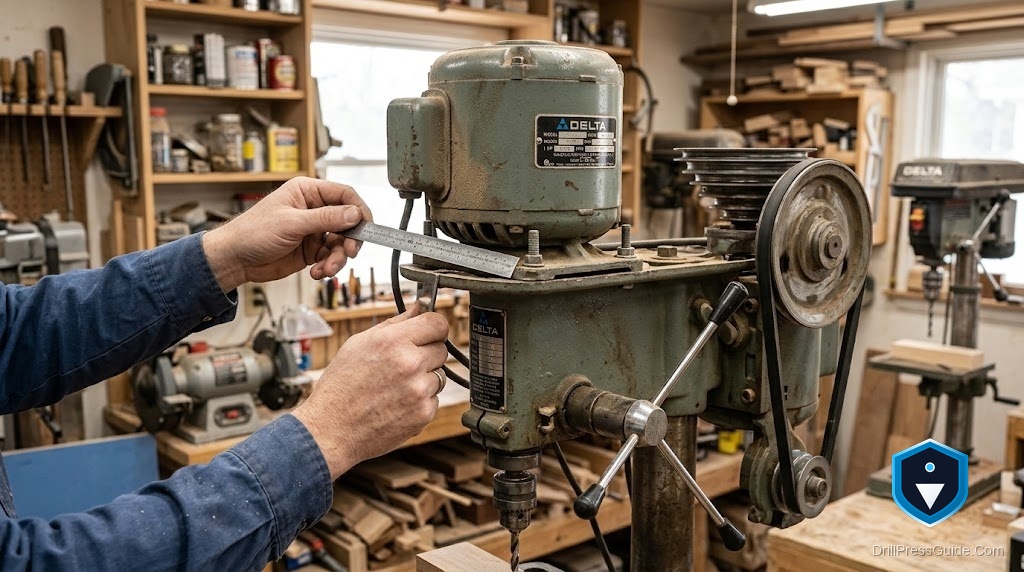
Replacing the motor means fitting a new electric motor to the press’s existing mount, wiring, and belt drive. On Delta benchtop and floor presses the motor is a fractional horsepower unit on a hinged or bolted bracket, driving the spindle through a V belt and a step pulley.
The direct answer: read the failing motor’s data plate and match horsepower, RPM, voltage, frame, and shaft diameter. Match those and the swap is an evening’s work. Miss the frame or shaft and you will be drilling out brackets or buying a second part.
Diagnose before you condemn the motor
A motor that will not start is not always a dead motor. Check the simple failures first:
- Start capacitor. A single phase motor that hums but will not spin often has a failed capacitor, a far simpler fix than the motor.
- Switch and cord. A worn power switch or a nicked cord can mimic a dead motor. Inspect both.
- Seized bearings. If the shaft will not turn by hand with the belt off, the bearings may be gone, which sometimes justifies a new motor.
If the windings are truly cooked, then it is replacement time.
Match five specs off the data plate
- Horsepower. Delta home presses commonly used 1/3 to 3/4 HP. Match what you had unless you have a specific reason to go up.
- RPM. Often 1725 RPM. Your speed chart assumes this figure, so keep it unless you plan to rework the pulleys.
- Voltage. Usually 115V on home units, though larger floor Deltas may be wired 115/230V.
- Frame size. A 56 frame is the modern fractional standard with a fixed bolt pattern, so matching the frame usually means the holes line up.
- Shaft diameter. Older presses often used a 1/2 inch shaft, while a modern 56 frame is often 5/8 inch. If the new shaft is larger than your pulley bore, the pulley will not fit.
Find the model and date first
Before any of this, find the model number, serial number, and manufacture date on the ID label, usually on the head casting or column. A floor Delta from the 1980s and a recent benchtop share a name and almost nothing else, so the label is what lets you match parts and speeds accurately.
Parts and tools
- A replacement drill press motor in a 56 frame matched to your plate.
- A drill press V belt, because a new motor deserves a fresh belt.
- A pulley puller so you can move the old pulley without cracking it.
The swap
- Unplug the press and photograph the wiring.
- Release belt tension and remove the belt.
- Pull the pulley off the old shaft with a puller. Never pry on cast pulley ribs.
- Unbolt the motor from the bracket.
- Mount the new motor, transfer or fit the pulley, and set the key.
- Wire to match the old connections. Confirm rotation before belting up.
- Reinstall the belt, set tension so it deflects slightly under a finger, and turn by hand before power.
Where it goes wrong
Buying on horsepower alone is the top mistake, because a strong motor that will not bolt to your bracket helps nobody. Ignoring shaft diameter is the second, since a mismatched shaft and pulley bore stops the job cold. Chasing an exact odd vintage RPM is the third, when a standard 1725 RPM motor plus a pulley tweak usually recreates your working speeds.
The verdict
A Delta motor swap rewards the person who reads the data plate and frustrates the one who eyeballs it. Diagnose first, because a capacitor or switch may be the real fault. If the motor is genuinely done, match horsepower, RPM, voltage, frame, and shaft, and settle the pulley question before ordering. For most home Deltas, a 1/2 HP, 1725 RPM, 56 frame motor is the honest sweet spot.
Three takeaways:
- Rule out the capacitor, switch, and cord before condemning the motor.
- The data plate’s five specs decide the fit.
- Shaft versus pulley bore decides if you also buy a pulley.
FAQ
What replacement motor fits a Delta drill press? One that matches the old motor’s horsepower, RPM, voltage, frame size, and shaft diameter. Read those off the data plate and buy to match.
How do I know if my motor is dead or just needs a capacitor? A motor that hums but will not spin often has a failed start capacitor. If the shaft turns freely by hand and only hums under power, test or replace the capacitor before buying a motor.
Will a 56 frame motor fit my Delta? The 56 frame bolt pattern is standardized, so it usually lines up with a 56 frame mount. Confirm shaft diameter so your pulley fits.
My Delta is wired for 230V. Can I use a 115V motor? Use a motor that supports your circuit. Many motors are dual voltage (115/230V) and can be wired for either, so check the motor’s wiring diagram.
Do I need to match the exact RPM? Keep the RPM if you want your speed chart to stay accurate. A different RPM changes every spindle speed unless you also change pulleys.
Should I replace the belt too? Yes. A fresh belt prevents slip and vibration that would otherwise get blamed on the new motor.
Where is the model and serial number on a Delta drill press? Usually on an ID label on the head casting or column. Use it to match parts and speeds to your exact machine.
References
- The Engineering ToolBox, Belts: Pulley Diameters vs. Speed. https://www.engineeringtoolbox.com/pulley-diameters-speeds-d_1620.html
- Occupational Safety and Health Administration, Woodworking eTool: Drill Presses. https://www.osha.gov/etools/woodworking/production/machines-tools/drill-press