
A Practical Guide to Drill Press Motor Replacement
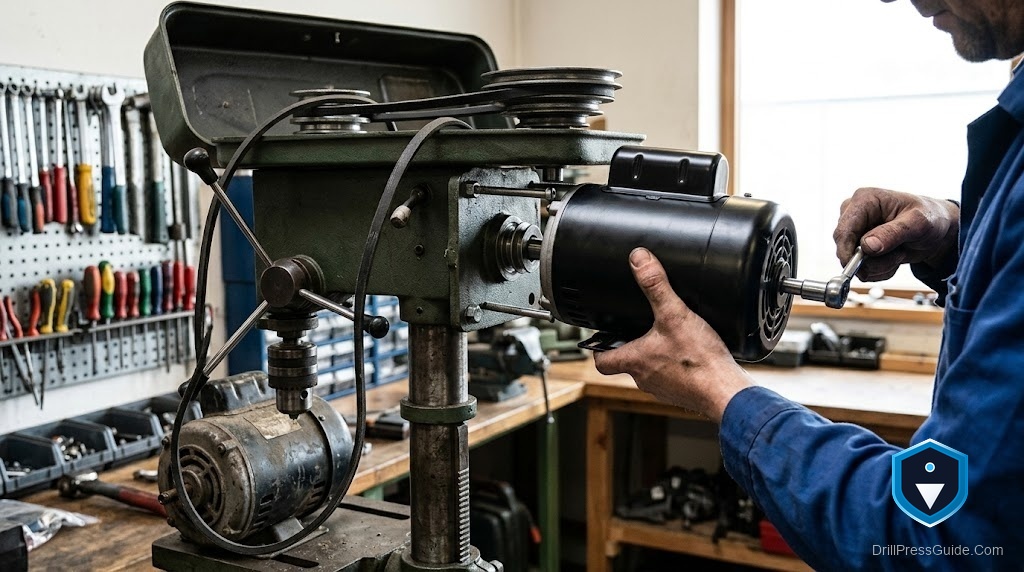
Replacing a drill press motor is a more involved repair than changing a belt or chuck, but it is entirely manageable if you approach it methodically. The critical steps are: confirm the motor is actually the problem (not the switch, capacitor, or power supply), find a replacement that matches the original in mounting frame, shaft size, RPM, and voltage, and reinstall with the belt aligned and tensioned correctly. Get those three right and the replacement motor runs as well as or better than the original. Shortcut any of them and you are back at the machine with a new motor and the same problem. This guide covers each step.
Straight answer: before ordering a motor, confirm the fault is in the motor itself (not the start capacitor, switch, or wiring), record the motor’s nameplate data (HP, voltage, RPM, frame, shaft diameter and length), and find a replacement matching those specifications. A motor with the wrong RPM changes your speed range; a motor with the wrong frame does not mount without fabrication.
Step 1: Confirm the motor is the problem
Two common non-motor faults mimic motor failure:
- Start capacitor failure: Single-phase motors use a start capacitor that switches out after the motor reaches speed. A failed capacitor causes the motor to hum but not start, or to start slowly and run at low torque. Replace the capacitor first (a cheap, straightforward part) before concluding the motor is failed.
- Switch failure: A failed power switch passes no current; the motor does nothing. Test continuity through the switch with a multimeter before condemning the motor.
- Wiring: Inspect the lead connections at the motor terminal block for loose, burned, or corroded contacts.
If the motor runs hot to the touch, smells burned, or produces visible smoke, the motor itself is likely the problem. A motor that spins freely by hand (with power off) but will not start under power is often a capacitor or switch issue.
Step 2: Record the nameplate data
Before ordering, read the motor’s nameplate and record:
- HP (horsepower): Typical drill press motors are 1/4 HP, 1/3 HP, 1/2 HP, 3/4 HP, or 1 HP.
- Voltage and phase: 115V or 230V single-phase for most shop presses.
- RPM: The motor’s full-load speed. This matters because the step-pulley ratios are designed for a specific motor RPM (typically 1,725 or 3,450 RPM). Replacing a 1,725 RPM motor with a 3,450 RPM motor doubles every spindle speed.
- Frame size: NEMA frame codes (e.g., 48, 56) specify the mounting hole pattern and shaft height. The replacement must be the same frame or the motor base will not align.
- Shaft diameter and length: The original pulley must fit the replacement shaft, or the pulley must be rebored.
- Rotation direction: Most motors are reversible, but confirm.
Step 3: Find the replacement
Three sourcing paths:
- OEM part: The machine’s parts diagram lists the motor part number. Check the manufacturer’s parts site (craftsman.com, deltamachinery.com, wenproducts.com, or equivalent). OEM replacement is the most reliable fit.
- NEMA-frame generic replacement: A motor matching the nameplate specifications from Grainger, Amazon, or an electrical supply house. Filter by HP, frame, voltage, and RPM. A generic NEMA 56-frame 1/2 HP motor at 1,725 RPM is a direct drop-in for any machine originally using that specification.
- Used OEM: eBay and machinist forums occasionally have original motors from donor machines. Useful when the machine is vintage and no generic motor exactly matches.
For 1/2 HP presses, a 1/2 HP NEMA 56-frame replacement motor is available from multiple suppliers; search by HP, frame, voltage, and RPM for your specific machine. Confirm shaft diameter (typically 5/8-inch) before ordering.
Step 4: The replacement
- Disconnect power completely and discharge the capacitor (touch the capacitor leads with an insulated screwdriver to short them safely).
- Photograph the belt routing, wiring, and motor position before disassembly. This is your reference for reassembly.
- Remove the V-belt from the motor pulley.
- Disconnect the motor wiring at the terminal block; label the leads.
- Remove the motor mounting bolts and slide the motor out of the mount.
- Transfer the pulley to the new motor shaft; align the pulley to the machine’s step pulley using a straightedge across both pulley faces. Lock the pulley set screw.
- Mount the new motor, connect the wiring (match the labels), route the belt.
- Tension the belt: the belt should deflect approximately 1/2 inch under moderate thumb pressure at the midpoint of the longest span. Too tight stresses bearings; too loose slips.
- Test at no load before drilling.
The honest flaws
Two honest points. First, if the machine is an import or discount brand with a non-NEMA motor (metric frame), finding a drop-in generic replacement is harder; confirm the frame standard before searching. Second, some original drill press motors are specially mounted (with the motor inside the head casting) in a way that requires OEM dimensions for fit; a generic motor may require bracket fabrication for these machines.
Conclusion: diagnose first, match nameplate, reinstall with correct belt tension
Drill press motor replacement is a manageable repair that starts with an accurate diagnosis.
- Confirm the motor, not the capacitor or switch, is the failure.
- Record HP, RPM, frame, voltage, and shaft diameter from the nameplate.
- Source OEM or NEMA-frame generic replacement matching all nameplate specs.
- Transfer pulley, align, tension belt (~1/2-inch deflection), test.
FAQ
How do I know if the start capacitor is bad? The motor hums when powered but does not start, or starts only with a hand-spin assist. Replace the capacitor before condemning the motor.
What is the NEMA frame number? A standardized code specifying the motor’s mounting hole pattern and shaft height. Common frames for drill press motors are 48 and 56.
What if the new motor’s shaft is a different diameter? The existing pulley must be rebored to the new shaft diameter (a machinist job) or a new pulley sourced with the correct bore.
Does motor RPM matter? Yes. Step-pulley ratios are designed for a specific motor RPM. A different RPM changes all spindle speeds proportionally.
How tight should the belt be? Approximately 1/2-inch deflection under firm thumb pressure at the belt’s midpoint. Tighter stresses bearings; looser causes slip and overheating.
Where do I find 1/2 HP replacement motors? Grainger, Amazon, and electrical supply houses. Filter by HP, NEMA frame, voltage, and RPM.
References
- NEMA motor frame standards reference: https://www.nema.org
- Grainger motor cross-reference: https://www.grainger.com
- SearsPartsDirect, Craftsman drill press motor by model: https://www.searspartsdirect.com


