3/4 HP Drill Press Motor: What It Is, Where It Fits, and What to Check
There’s a gap in most buying guides between “benchtop hobbyist” and “full industrial floor press,” and the 3/4 HP drill press motor lives squarely in that gap. It’s the motor class you reach for when a 1/3 HP machine has stalled on you one too many times — but you’re not ready to spend $800 on a floor-standing machine.
What a 3/4 HP Motor Changes
The jump from 1/3 HP to 3/4 HP (approximately 560 watts) delivers meaningfully more torque at low spindle speeds. Torque — not raw horsepower — is what you actually need when a large Forstner bit or a holesaw bites into hardwood or metal. The practical differences:
- Large-diameter Forstner bits (1 inch and above) in oak, maple, and hard ash become routine rather than stressful.
- Mild steel drilling up to 3/8 inch with HSS bits feels controlled — the motor doesn’t lug.
- Longer continuous use without thermal trips or cool-down pauses.
Where 3/4 HP Drill Presses Fit
Floor-Standing 3/4 HP
Floor presses in the 3/4 HP range — often 15- to 17-inch swing machines — are the workhorses of small professional shops and serious home workshops. They typically feature:
- 15–17 inch swing (7.5–8.5 inch throat depth)
- 3–4 inch quill travel
- Tilting cast-iron work table, often with T-slots
- 5-speed or variable-speed spindle
If you’re working with 2×4 lumber, sheet goods, or steel plate regularly, the floor-standing 3/4 HP machine is the minimum we’d recommend.
Key Specs to Verify Before You Buy
Work table
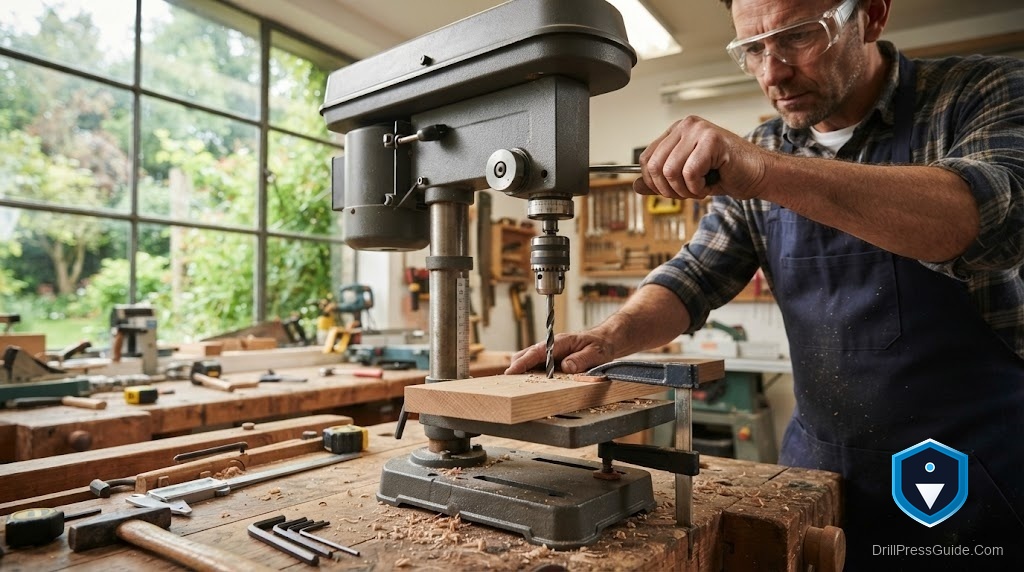
Look for a cast-iron table, T-slots for clamping, and a rack-and-pinion height mechanism. T-slots let you bolt a 3-inch drill press vise directly to the table. A quality chuck key that fits snugly is essential for a machine at this level.
Replacing a 3/4 HP Motor: What to Check
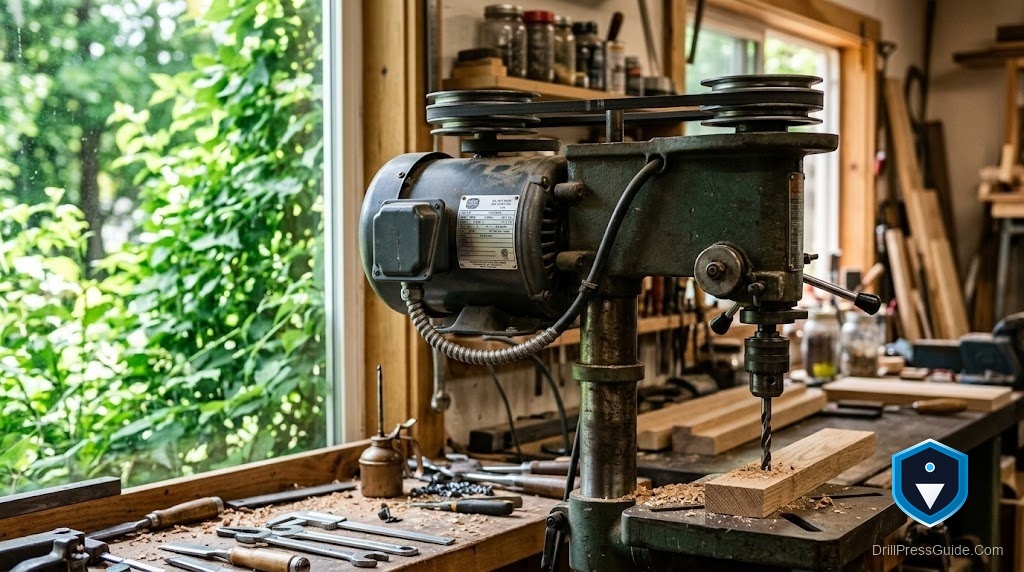
If you’re sourcing a 3/4 HP replacement drill press motor, these are the variables that matter:
- Shaft diameter and keyway — must match the existing pulley bore
- Frame size — NEMA 48 and 56 frames are common; verify from the original motor’s nameplate
- Rotation direction — confirm, as drill press spindles rotate clockwise viewed from above
- Capacitor — single-phase motors use a start capacitor; if the motor hums but won’t start, test or replace the capacitor before condemning the motor
- Voltage — most 3/4 HP single-phase motors are dual-voltage (120V or 240V)
Illuminating Your Work
Floor-standing 3/4 HP machines cast a deep shadow from the spindle housing onto the work table. A magnetic LED work light that clamps to the column is cheap insurance against misplaced holes.
Our Recommendation
For most serious hobbyists and part-time professionals, a floor-standing 3/4 HP drill press in the JET or comparable mid-range tier is the machine to buy and keep for a decade. Buy it once. Set it up properly. Keep the chuck key where it belongs. Use a vise.
SEO Metadata