
1/3 HP Drill Press Motor: Capacity, Setup, and Everyday Use
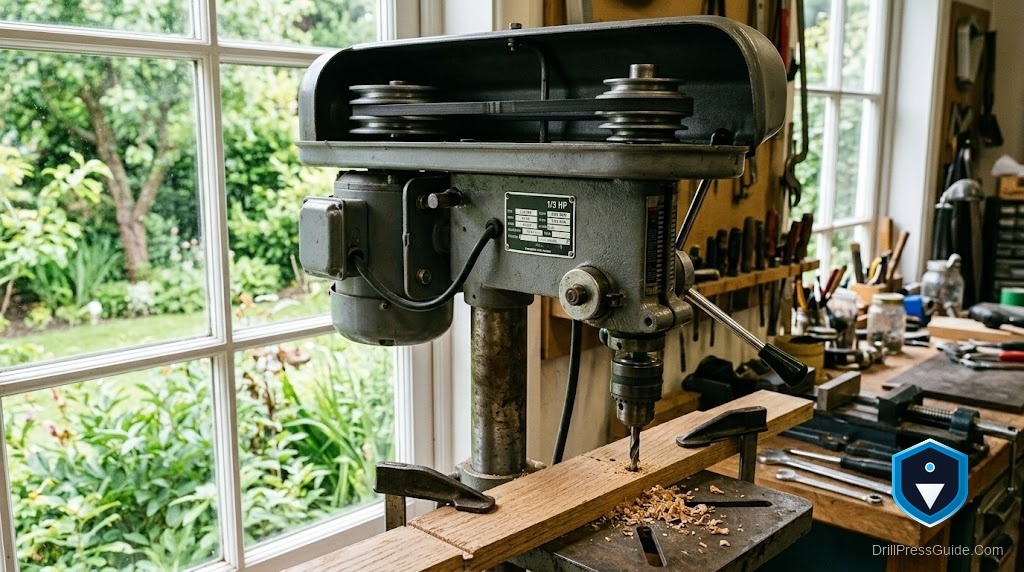
If you’ve been shopping for a benchtop drill press and keep seeing “1/3 HP” on the spec sheet, you’ve probably wondered whether that’s enough — or whether you’re getting a toy. We’ve drilled through hardwood, mild steel, and everything in between with these machines, and the honest answer is more nuanced than most buying guides let on.
What “1/3 HP” Actually Means on a Drill Press
Horsepower on a drill press motor describes the continuous output of the induction motor that spins the spindle. A 1/3 HP (roughly 249 watts) induction motor is a single-phase unit — almost always running on standard 120V household current — designed for intermittent shop use.
Key specs to read alongside horsepower
| Spec | What to look for |
|---|---|
| Swing | Distance from column centerline to chuck centerline × 2 |
| Spindle travel (quill travel) | 2–3 inches is standard for benchtop 1/3 HP models |
| Spindle taper | Most benchtop presses use MT2; verify before buying a chuck or arbor |
| Chuck size | 1/2-inch keyed chuck is most common; a quality chuck key is not optional |
| Speed range | Wider range = more material versatility |
| Depth stop | Micro-adjustable stops save setup time on repeated holes |
| Work table | Tilting ±45° is standard; rack-and-pinion height adjustment is a bonus |
Is a 1/3 HP Motor Enough?
Where 1/3 HP excels
- Wood up to 1.5 inches thick. Softwood, hardwood, MDF, plywood — the 1/3 HP motor handles it easily when you choose the right bit speed and use sharp bits.
- Thin steel and aluminum. Drilling 1/4-inch or thinner mild steel with HSS bits at low speed? No problem.
- Repetitive light production work. Jigged holes in cabinet doors, pilot holes in furniture stock, model making.
Where it struggles
- Large-diameter holes in hardwood or steel. A 1-inch Forstner bit in hard maple will stall or overheat a 1/3 HP motor if you push it.
- Continuous runtime. Induction motors in this class aren’t rated for hours-long continuous use.
- Deep holes. If you regularly need holes deeper than 2–3 inches, the quill travel on most 1/3 HP benchtop models becomes the limiting factor before the motor does.
Setting Up a 1/3 HP Drill Press
1. Mount the chuck properly
Most 1/3 HP benchtop presses ship with a keyed chuck on a Jacobs-taper arbor that presses into an MT2 spindle taper. Keep a dedicated chuck key in the chuck key holder. If you ever need to upgrade to a JT33 chuck for better runout on smaller bits, this keyed chuck fits most benchtop presses.
2. Set the belt for the right speed
| Material | Bit diameter | Approximate speed |
|---|---|---|
| Softwood | Up to 1” | 1,500–3,000 RPM |
| Hardwood | Up to 3/4” | 1,000–2,000 RPM |
| Mild steel | Up to 1/4” | 300–600 RPM |
| Aluminum | Up to 1/2” | 1,500–2,500 RPM |
3. Set the depth stop
The depth stop — a pair of locking nuts on the quill rod — prevents the quill from dropping past a set point. For repetitive holes, lock the stop to the exact depth you need.
4. Secure your workpiece
A 3-inch drill press vise bolted to the work table transforms the machine. For larger stock, a 4-inch vise adds the jaw capacity to handle thicker boards.
Everyday Use Tips
Use sharp bits. More than any other variable, dull bits stress the motor and produce wandering, ragged holes.
Illuminate your work. A magnetic LED work light attached to the column makes a real difference in hole placement accuracy.
When to Step Up to More Horsepower
You’ve outgrown a 1/3 HP motor if you regularly:
- Drill holes larger than 3/4 inch in any hardwood
- Work with steel thicker than 3/16 inch
- Need hole depths greater than 3 inches regularly
- Run the machine for more than 30–45 minutes continuously
SEO Metadata


