
1/2 HP Drill Press Motor: A Practical Guide for the Workshop
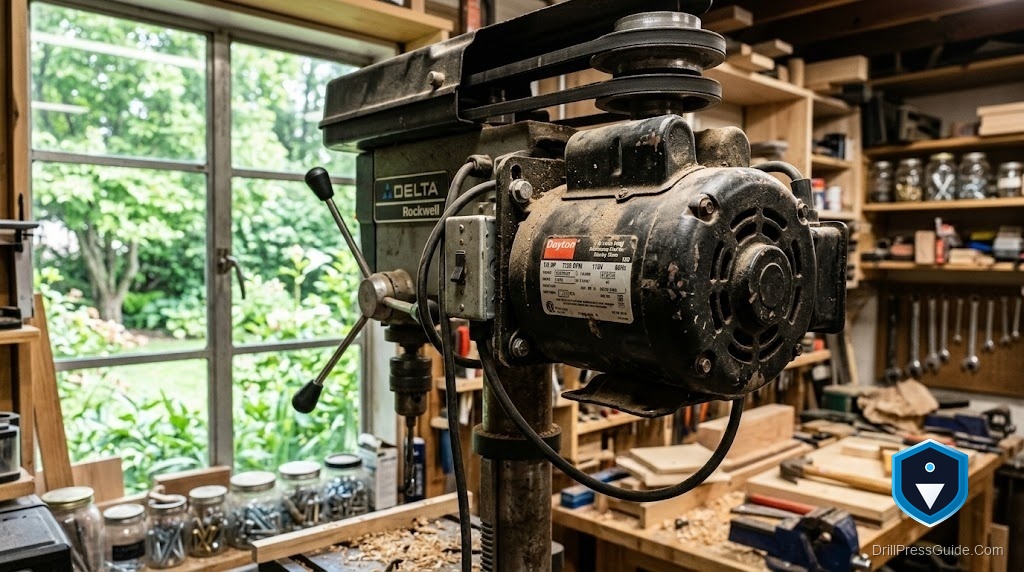
The motor is the heart of your drill press, and when it starts humming oddly, running slow, or refuses to start at all, everything stops. If you’ve been trying to figure out whether a 1/2 HP motor is right for your machine — or whether it’s time to replace the one you have — this guide walks through what actually matters.
What Does 1/2 HP Actually Mean for a Drill Press?
Horsepower is a measure of the motor’s sustained work capacity. A 1/2 HP induction motor is the most common spec on mid-range bench and floor drill presses. It’s enough for:
- Bits up to 1/2 inch in most metals
- Forstner bits and spade bits up to 1-1/2 inch in wood
- Hole saws up to about 2 inches in soft materials
- Consistent drilling without the motor bogging under steady feed pressure
Where a 1/4 HP motor will audibly strain and slow on heavier cuts, a 1/2 HP motor holds its speed more cleanly. That consistency matters for clean holes and for extending the life of your bits.
1/2 HP vs. 1/3 HP vs. 1 HP: Choosing the Right Motor
1/3 HP Drill Press Motor
The Craftsman 1/3 HP drill press motor is the classic example. It’s adequate for hobby-level woodworking, and commonly found on older 8-inch swing benchtop machines. For occasional use on soft materials it holds up fine. For regular shop work on hardwood or metal, it’s undersized.
1/2 HP Drill Press Motor
This is the sweet spot for most home workshops and light professional use. A 1/2 HP electric motor for drill press applications runs cool, handles sustained loads well, and is available in both single-phase 110V and 120V configurations that work on standard household circuits.
If you’re shopping a 1/2 HP drill press, you’re looking at models with:
- 12-inch to 15-inch swing
- MT2 spindle taper
- Keyed chuck with 1/2-inch chuck capacity
- 3-inch to 4-inch spindle travel
1 HP Drill Press Motor
Step up to 1 HP and you’re in floor-model territory — machines with 15-inch or larger swing, more spindle travel, and the torque to run large annular cutters in steel. For general woodworking, it’s more than you need.
Replacing a 1/2 HP Drill Press Motor: What to Check First
- Frame size — NEMA 48 or 56 frame is common. Check your OEM motor’s nameplate.
- RPM — typically 1725 RPM for 60 Hz, two-pole motors. Match the RPM to preserve your spindle speed range.
- Rotation direction — most drill press motors run clockwise when viewed from the shaft end.
- Shaft diameter — the motor shaft has to fit your existing drive pulley. Common sizes are 5/8 inch and 1/2 inch.
- Voltage — standard home shop motors run on 120V single phase.
The Belt Factor
Once you’ve got the motor sorted, don’t overlook the drive belt. Original V-belts on drill presses stretch over time, and a worn belt causes vibration that affects hole quality and accelerates motor bearing wear.
A link belt is a direct upgrade over the OEM V-belt on most machines. It’s made of interlocking polyurethane segments that you cut to length, so it fits any pulley configuration without custom ordering. Installation takes about five minutes, it runs quieter than a standard V-belt.
Workholding Matters Too
A freehand-held workpiece on a drill press is a genuine hazard. A 3-inch drill press vise is ideal for bench-top machines. If you’re working with larger stock, a 4-inch vise gives you more jaw capacity.
The Bottom Line
A 1/2 HP induction motor is the practical standard for home workshop drill presses — enough torque for real metalwork and hardwood, available on standard household current, and replaceable without a special-order motor. If your current motor is failing, replacement is straightforward as long as you match frame size, RPM, shaft diameter, and voltage before you order.
SEO Metadata


