
A Closer Look at the Guardian Power Drill Press BDM-58-5S
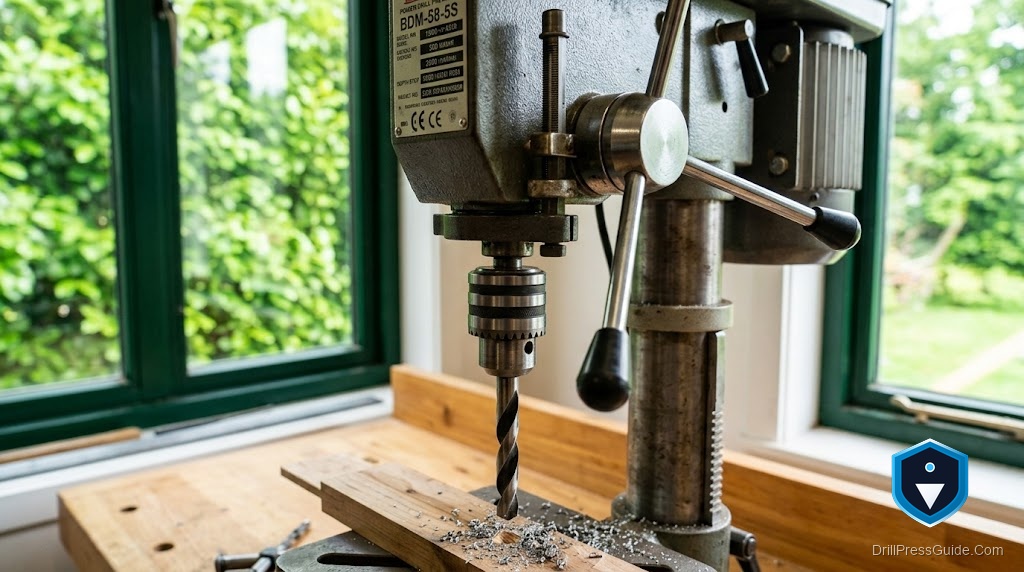
There’s a particular kind of satisfaction that comes from rescuing an old drill press. You find it at an estate sale, dusty and forgotten in the corner of a garage. You wipe it down, spin the quill by hand, and if it turns smooth and true, you know you’ve found something worth saving.
The Guardian Power BDM-58-5S is exactly that kind of machine. It doesn’t have a cult following like a Walker-Turner or a Powermatic. You won’t find a dedicated forum thread about it. But if you pick one up for the right price — and you know what to look for — you’ll have a solid, capable benchtop drill press that punches well above its garage-sale pedigree.
BDM vs. FDM: Bench vs. Floor — What’s the Difference?
Guardian Power made drill presses under two main designations: BDM (Bench Drill Machine) and FDM (Floor Drill Machine). The difference is exactly what it sounds like.
The BDM-58-5S is a benchtop unit. It mounts on a workbench or stand and stands roughly 26–28 inches tall from base to head. The FDM version adds a longer column and a floor-standing base, giving you full floor-press geometry.
Why does this matter? If you find a listing that says “Guardian Power drill press” without specifying BDM or FDM, check the column length before you drive across town. A benchtop machine on a floor stand is not the same as an FDM. The BDM was engineered as a compact unit; the motor mounting, belt cover, and table geometry are all scaled accordingly.
The 58-5S designation breaks down like this:
- 58 refers to the swing — the distance from the column centerline to the spindle centerline, doubled. On this machine, that’s a 5-inch swing from the column, giving you a 10-inch maximum workpiece diameter under the drill.
- 5S = five speeds.
So: 10-inch swing, five-speed, benchtop configuration.
Specs at a Glance
| Specification | Detail |
|---|---|
| Swing | 10 inches |
| Spindle Travel (Quill) | 2.5 inches |
| Speeds | 5 |
| RPM Range | ~620–3,100 RPM (typical for this class) |
| Motor | 1/3 HP, 120V single-phase |
| Chuck | JT33 taper |
| Table Tilt | ±45° |
| Table Size | ~6.5” × 6.5” cast iron |
| Drive Type | V-belt, 5-step pulleys |
Note: Exact RPM figures vary by unit condition and belt wear. Always verify with a tachometer if precision matters.
The Five-Speed Belt Configuration
The BDM-58-5S uses a single V-belt routed across a two-step motor pulley and a five-step spindle pulley. The belt runs in a straight line across matching pulley diameters. The five usable pairings give you five discrete speeds.
The belt itself is a standard 4L (or equivalent) fractional V-belt. The exact length depends on pulley center-to-center distance, but most units in this class use something in the 4L230 to 4L250 range. Always measure your existing belt before ordering.
One upgrade worth serious consideration: a link belt. Traditional V-belts transmit vibration directly through to the spindle, which you feel as runout and hear as a low hum. A link belt like this one lets you dial in the exact length you need and dramatically reduces vibration. On an older machine with slightly worn pulleys, a link belt often makes more difference than any other single upgrade.
Inspection Checklist for Used Units
If you’re buying a BDM-58-5S used — and you almost certainly are, since these aren’t in current production — here’s what to check before you hand over any cash.
1. Quill Movement Pull the quill down by hand with the depth stop removed. It should move smoothly and spring back without stiction. If it drags, the quill bushing may be worn or the quill itself may be galled.
2. Spindle Runout Chuck a known-straight rod and bring the spindle up to speed. Put a dial indicator against the rod just below the chuck jaws. Anything under 0.005” is acceptable for woodworking; metalworking wants under 0.003”.
3. Table Condition The cast iron table should be flat. Bring a small straightedge. Surface rust is cosmetic and can be cleaned up with a wire wheel and paste wax. Cracks or broken tilt ears are structural problems — walk away.
4. Belt and Pulleys Spin the pulleys by hand with the belt removed. Rough bearings feel gritty. Look at the belt for cracking, glazing, or fraying. Budget for a new belt regardless; old belts slip and wear fast.
5. Column Straightness Sight down the column from the top. It should be straight, not bowed. A bent column means everything you drill will be slightly off-axis. Not fixable without a new column.
6. Chuck Older units often have the original chuck, which may be a JT33 taper-mount. Test for wobble. If the chuck is shot, replacing it is easy and inexpensive — a quality JT33 keyed chuck runs under $30 and installs in five minutes with a wooden mallet. Don’t forget a proper chuck key if one wasn’t included.
7. Depth Stop The depth stop should lock positively and not creep under drilling pressure.
8. Wiring On machines this age, check the power cord for cracking insulation and the switch for clean operation.
Honest Limitations
Motor power is modest. At 1/3 HP, you’ll bog down in anything beyond medium-density hardwood or aluminum with large Forstner bits. Slow your feed rate, run the right speed, and it’ll get through the job. Push it and the motor will complain loudly.
Depth-of-swing is limited. Ten inches of swing means you can center-drill a 10-inch-wide workpiece — but just barely, with nothing to spare on the fence. For large panel work, this machine will frustrate you.
Parts availability is a real concern. Guardian Power was never a major brand, and sourcing original parts today is difficult. The good news: most serviceable components (bearings, belts, chucks, arbors) are generic enough to source from third-party suppliers.
No laser or LED light. On a machine this age, you’re drilling by eye or adding your own magnetic LED work light clamped to the column. Honestly, an aftermarket magnetic light is often better positioned than factory-installed lights anyway.
Best Uses
For what it is — a compact, all-iron, five-speed benchtop drill press — the BDM-58-5S excels at:
- Woodworking: Dowel holes, hinge mortising with a Forstner bit, shelf pin holes, through-tenon cleanup.
- Metalworking (light): Drilling steel up to about 1/2 inch in mild stock, tapping soft metals with the quill set at low RPM.
- Lutherie and instrument making: The small footprint fits cramped shops; the 5-speed range handles everything from large roughing bits to tiny brad points.
- Hobby and model work: Precision drilling for small components where a hand drill won’t give you the repeatability you need.
Adding a WEN 3-inch drill press vise to the table transforms this machine for metalwork — holding your stock securely is non-negotiable when drilling metal, and a vise that bolts through the table slots keeps things honest.
How It Compares
| Feature | Guardian BDM-58-5S | Ryobi DP103L | WEN 4208 |
|---|---|---|---|
| Swing | 10” | 10” | 8” |
| Speeds | 5 | 5 | 5 |
| Table Material | Cast iron | Cast iron | Cast iron |
| Motor | 1/3 HP | 1/3 HP | 1/3 HP |
| Chuck Size | 1/2” | 1/2” | 1/2” |
| Chuck Taper | JT33 | JT33 | JT33 |
| Belt Type | V-belt | V-belt | V-belt |
| New/Used | Used only | New/Used | New |
| Price Range (used) | $40–$120 | $60–$150 | $90–$130 |
| Parts Availability | Difficult | Moderate | Good |
vs. Ryobi DP103L: The Ryobi is newer, so parts are easier to find, and units in good condition are more plentiful. But build quality is comparable — both machines are all-iron construction. If you can find a clean BDM-58-5S for significantly less than a DP103L, the Guardian is the better buy.
vs. WEN 4208: The WEN 4208 is the current entry-level benchmark. It’s new, it’s under warranty, and WEN’s customer service is genuinely responsive. If you’re not comfortable gambling on a used machine or doing your own maintenance, buy the WEN. But if you know how to check bearings and aren’t afraid of a wire brush, the Guardian — at used prices — gives you a heavier table and column for the money.
FAQ
Q: Where can I find the manual for the Guardian Power BDM-58-5S? A: Guardian Power manuals are not widely archived. Check VintageMachinery.org, OWWM.org, and general Google searches. In the absence of a manual, the machine is intuitive enough that most experienced woodworkers can operate it safely without one.
Q: What belt do I need for the BDM-58-5S? A: Most units in this class use a 4L-series fractional V-belt. Measure your existing belt or measure the pulley center-to-center distance. A link belt is worth considering as an upgrade.
Q: What chuck taper does the BDM-58-5S use? A: JT33 (Jacobs Taper #33). This is a common benchtop press taper. Replacement chucks are easy to find — a quality JT33 keyed chuck installs with a wooden mallet.
Q: Can I use this drill press for metal? A: Yes, for light metalwork. Drilling mild steel up to about 1/2 inch, tapping aluminum, and similar tasks are well within this machine’s range. Use a proper cutting fluid, run the right RPM for your bit diameter and material, and secure your stock in a drill press vise.
Q: Is the Guardian BDM different from other “Guardian Power” drill presses? A: Yes. Guardian Power made several drill press models under different designations. BDM = benchtop, FDM = floor. The “58” refers to the swing, and “5S” indicates five speeds.
Q: My quill sticks or is stiff. What should I do? A: Clean the quill thoroughly with a degreaser, inspect for galling or rust, and lubricate with a thin machine oil. If the problem persists, the quill bushing may need replacement or honing by a machinist.
Q: Can I convert this to a floor press? A: Practically, it’s often cheaper and simpler to buy a dedicated floor press. A better option is mounting the BDM on a sturdy shop-built stand.
Q: What’s the RPM range, exactly? A: Typical for this class is roughly 620 RPM (lowest) to 3,100 RPM (highest), but individual units vary based on pulley condition and wear. Verify with a tachometer if precision matters for your work.
Q: Should I buy a Guardian BDM-58-5S or something new? A: If you find a clean, running example for under $80, it’s hard to beat for a first drill press or a dedicated secondary machine. If the market in your area only has rough examples asking full price, consider a new WEN 4208 for the warranty and parts support.
Q: Where do I find parts? A: Generic parts (belts, bearings, chucks, arbors) are sourced from any industrial supply. Model-specific parts are harder — search eBay and Craigslist for parts machines.
SEO Metadata


