1/2 HP Electric Motor for a Drill Press: Specs to Match Before You Buy
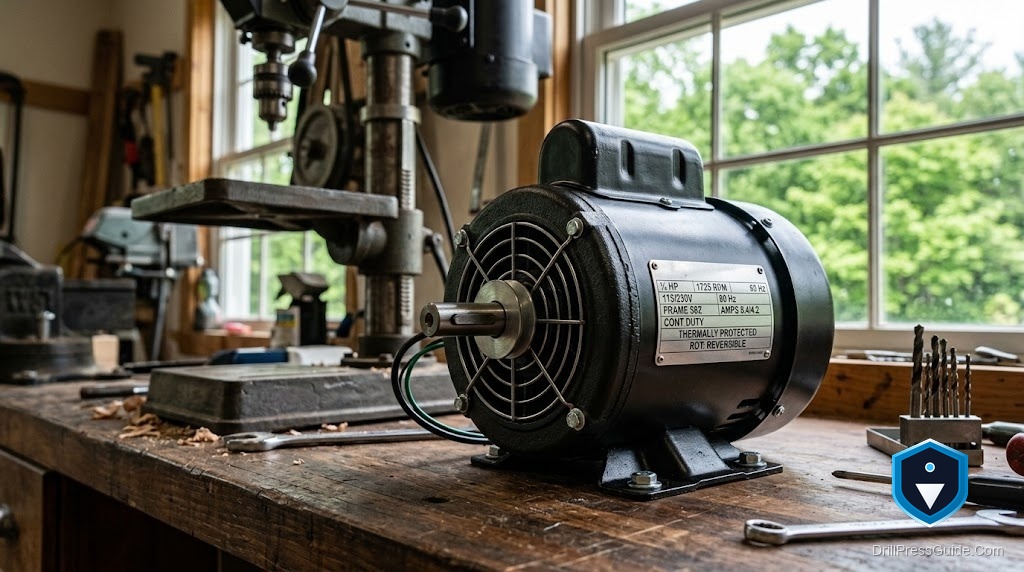
Replacing the motor on a drill press sounds straightforward until you realize that horsepower is only one number on a long list of specs that have to align. A 1/2 HP motor that does not match your drill press’s frame size, shaft diameter, mount style, or voltage will not install without fabricating a custom adapter, and sometimes not at all. Before you order anything, you need to understand what you are matching and why each spec matters.
What Does 1/2 HP Actually Cover?
A 1/2 HP induction motor is appropriate for benchtop drill presses in the 8-inch to 10-inch class. If you are working with a floor-standing press over 14 inches in swing, 1/2 HP is almost always underpowered. Floor presses in the 15-inch to 17-inch range typically came from the factory with 3/4 HP or 1 HP motors, and replacing a 3/4 HP motor with a 1/2 HP unit will result in stalling under any meaningful load.
Match the replacement motor’s HP to what the original spec sheet or data plate calls for.
The Specs That Must Match
NEMA Frame Size
The frame size is the most important dimension for physical fitment. It controls the motor’s bolt pattern, overall housing dimensions, and shaft location.
NEMA 48. Compact frame, common on smaller benchtop drill press motors in the 1/3 HP to 1/2 HP range. Shaft diameter is typically 1/2 inch.
NEMA 56. Slightly larger frame, used on motors from 1/2 HP through 1 HP and above. Shaft diameter is typically 5/8 inch on most 56-frame motors.
Your replacement motor must be the same NEMA frame as the original to bolt into the existing motor mount without modification.
Shaft Diameter
The motor pulley is bored to match the shaft. The most common shaft sizes on drill press motors:
- 1/2 inch (common on NEMA 48 motors)
- 5/8 inch (standard on most NEMA 56 motors)
If you change shaft diameter, you need a new pulley as well.
RPM
Almost all drill press replacement motors are 1,725 RPM (four-pole, 60 Hz). A 3,450 RPM motor connected to the same pulley system will run the spindle at roughly twice the designed speed range, which is unsafe.
Voltage
Small drill press motors come in three common configurations:
- 120V only. Standard residential outlet.
- 120V/240V dual voltage. Preferred if you have 240V available.
- 240V only. Requires a dedicated circuit.
Rotation Direction
Most drill press motors rotate counterclockwise when viewed from the shaft end. Confirm by checking the original motor’s label.
Mount Type: C-Face vs. Foot Mount
Foot mount motors bolt to a baseplate, which is the standard for most drill presses where the motor sits on a pivoting plate to maintain belt tension. C-face motors have a flanged face and are not interchangeable without an adapter.
The Honest Flaw
A motor that matches the horsepower but gets the frame, shaft, or mount wrong will not install directly. Adapting a wrong-frame motor requires fabricating a mounting plate or machining a bushing, work that costs more in time and money than simply buying the correct motor. Do not skip the frame and shaft verification step.
Who Should Skip DIY Motor Replacement?
If you are not comfortable with basic electrical wiring or unfamiliar with motor frame specifications, motor replacement is the wrong starting point. Incorrectly wired motors create shock and fire hazards. In that situation, take the press to a local motor rewinding shop.
Where to Buy a 1/2 HP Replacement Motor
Grainger. The most complete motor catalog with full NEMA frame, shaft, RPM, voltage, and mount data listed for every SKU.
Northern Tool. Carries a focused selection of small shop motors, often in-store same-day.
Amazon. Wide range, but verify the manufacturer’s data sheet rather than just the listing title before ordering.
Local motor rewinding shops. Often the best source for vintage or uncommon frame sizes.
Key Specs to Verify
| Spec | Typical Value for 8-10” Benchtop | Why It Matters |
|---|---|---|
| HP | 1/2 HP | Determines load capacity |
| NEMA frame | 48 or 56 | Controls bolt pattern and fitment |
| Shaft diameter | 1/2” or 5/8” | Determines pulley compatibility |
| RPM | 1,725 | Determines spindle speed range |
| Voltage | 120V or 120/240V | Must match available power |
| Rotation | CCW from shaft end | Determines chuck rotation direction |
| Mount type | Foot mount | Must match motor plate design |
Conclusion
Replacing a drill press motor with a 1/2 HP unit is a practical repair for any 8-inch to 10-inch benchtop press, but HP is only one number that has to match. Confirm NEMA frame, shaft diameter, RPM, voltage, rotation direction, and mount type before ordering. A motor that matches on HP but misses any other spec will require fabrication to install. For a 14-inch or larger floor press, move up to 3/4 HP or 1 HP.
FAQ
What HP motor does a drill press need? Benchtop presses (8-10 inch) typically use 1/3 to 1/2 HP. Floor presses 14 inches and larger typically use 3/4 HP to 1 HP or more.
What NEMA frame is a drill press motor? Most small benchtop drill press motors use NEMA 48 or NEMA 56 frames.
What RPM should a drill press motor be? 1,725 RPM (four-pole, 60 Hz).
Can I replace a 3/4 HP motor with a 1/2 HP motor? Not recommended. A larger press will stall under load with a smaller motor.
What is the shaft diameter on a drill press motor? The most common sizes are 1/2 inch (NEMA 48) and 5/8 inch (NEMA 56).
Where can I buy a replacement 1/2 HP motor? Grainger, Northern Tool, Amazon, and local motor rewinding shops.
What is TEFC? Totally Enclosed Fan Cooled. Preferred for shop environments where dust and chips are present.
Is motor replacement safe for a DIYer? The mechanical part is straightforward. Wiring involves 120V or 240V connections. If not confident, have a qualified shop handle the wiring.
References
- NEMA MG 1: Motors and Generators, National Electrical Manufacturers Association
- Grainger motor catalog: grainger.com
- WEN Products Drill Press FAQs: wenproducts.com
- OSHA 29 CFR 1910.147, Lockout/Tagout
- CCOHS, Electrical Safety: ccohs.ca