
Drill Press Accessories: What Actually Earns Its Place
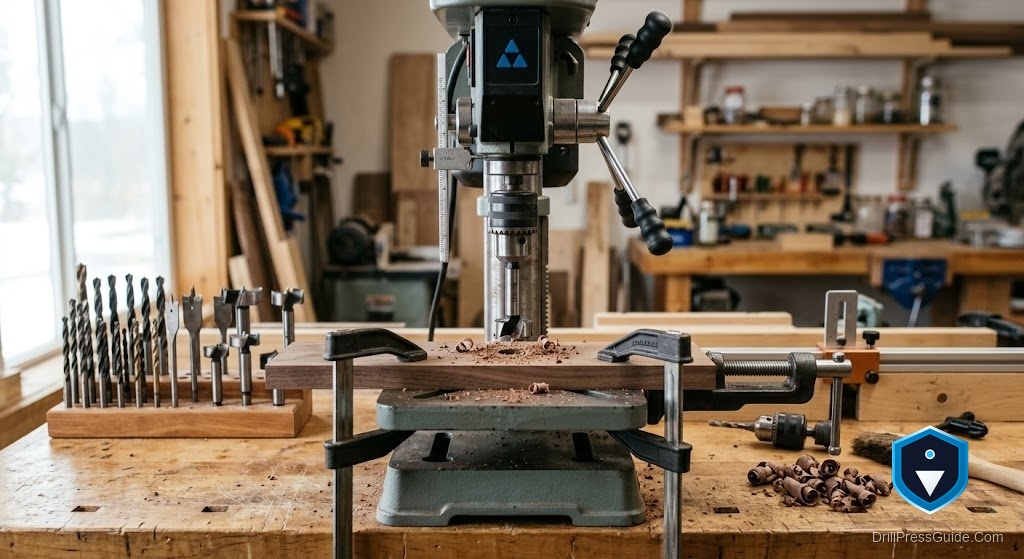
The drill press is one of the most upgradable machines in the shop, and the accessory aisle knows it. There is a gadget for every part of the machine, some of them genuinely transformative and some of them clutter that gathers dust after the novelty wears off. Knowing which accessories actually earn their place, and which solve a problem you do not have, is what turns a bare drill press into a machine that does more work more safely without draining your wallet on things you never reach for. This guide sorts the accessories worth owning from the ones that are not.
A drill press accessory is any add-on that expands what the machine can do or makes it safer and more accurate: work-holding, tooling, depth and position aids, and safety equipment. The best accessories address a real limitation of the bare machine, holding work securely, positioning it precisely, drilling to a repeatable depth, and those are the ones worth buying first. The rest range from useful-for-some to skip-it, depending entirely on the work you do.
The accessories that earn their place first
A few accessories improve nearly every drill press, and they are where to spend first.
A drill press vise. The single most valuable accessory, because holding metal by hand is unsafe and inaccurate. A cast-iron drill press vise bolted to the table clamps stock securely against the drilling torque, improving both safety and hole quality on every metal job. Size it to your table.
A quality chuck. If the machine’s chuck runs out and drills off center, a good chuck fixes it. Confirm the arbor taper, commonly JT33, and a standard JT33 keyed chuck restores true, centered holes once the old one is off.
A depth stop, if the machine lacks a good one, for repeatable holes, and a work light and safety guard for seeing and staying clear of the spindle. These address the bare machine’s real limitations and pay off on ordinary work.
Accessories that earn their place for specific work
These are excellent for the shops that need them and unnecessary for those that do not.
A cross-slide vise. For work that must be positioned precisely under the spindle in two axes, hole patterns, light coordinate work, a cross-slide drill press vise lets you dial in position, at the cost of some rigidity and added height. Worth it if you position precisely, overkill if you drill single holes.
A tapping head, for shops cutting many threads; a mortising attachment, for woodworkers cutting square holes; a drum sander drum, for light sanding; and a fence or table upgrade, for repeatable woodworking setups. Each is genuinely useful for its niche and pointless outside it, so buy by the work you actually do.
Maintenance parts worth keeping on hand
Some accessories are really maintenance items that keep the machine working. A spare drive belt matched to your machine, and a quill return spring assembly sized to your housing for when the original breaks, save downtime when a wear item fails. A can of rust protectant keeps the cast-iron table and column clean. These are not exciting, but they keep the machine in service.
What to skip
Be wary of accessories that promise to make the drill press something it is not. The most common trap is the milling attachment or cross-slide setup sold as a way to mill on a drill press: the spindle bearings are not built for the side loads of milling, so these disappoint and can damage the machine. Novelty jigs you will use once and gimmick attachments that duplicate a tool you already own are money better left in your pocket. The test is simple: does this solve a problem you actually have on work you actually do?
Conclusion
Drill press accessories range from transformative to clutter, and the difference is whether they address a real limitation of your work. Buy the essentials first, a solid vise, a true chuck, a depth stop, a light and guard, since those improve nearly every job. Add niche accessories like a cross-slide vise or tapping head only when your work calls for them, and keep wear parts like a spare belt and return spring on hand. Skip the milling attachments and novelty jigs that promise to make the press a machine it is not. Buy by the work you do, and every accessory in your drawer will earn its place.
Three takeaways: buy the essentials first (vise, true chuck, depth stop, light, guard), add niche accessories only for the work you actually do, and skip milling attachments and novelty jigs that overpromise.
Frequently Asked Questions
What is the most useful drill press accessory? A drill press vise, because holding metal by hand is unsafe and inaccurate. A cast-iron vise bolted to the table clamps stock securely against the drilling torque and improves both safety and hole quality on every metal job.
What accessories should I buy first? The essentials that address the bare machine’s limits: a solid vise, a true chuck if the original runs out, a depth stop for repeatable holes, and a work light and safety guard. These pay off on ordinary work.
Is a cross-slide vise worth it? For work that must be positioned precisely under the spindle in two axes, yes. For single-hole drilling it is overkill and adds height and reduces rigidity, so buy it only if you position precisely.
Can I turn my drill press into a milling machine with an accessory? No. The spindle bearings are not built for the side loads of milling, so milling attachments disappoint and can damage the machine. Use a mill for milling.
What maintenance parts should I keep on hand? A spare drive belt matched to your machine and a quill return spring sized to your housing, since those wear items cause downtime when they fail. A rust protectant for the cast-iron table also helps.
How do I decide if an accessory is worth buying? Ask whether it solves a problem you actually have on work you actually do. Accessories that address a real limitation earn their place; novelty jigs and gimmicks that duplicate existing tools do not.
References
- Jacobs Chuck Manufacturing, Mounting and Removing Chucks. http://www.jacobschuck.com/uploads/ueditor/file/20200604/1591240204146153.pdf
- VintageMachinery.org, machine tool references and literature. http://vintagemachinery.org


