
How to Make a Drill Press Stand: A Clear, Shop-Ready Method
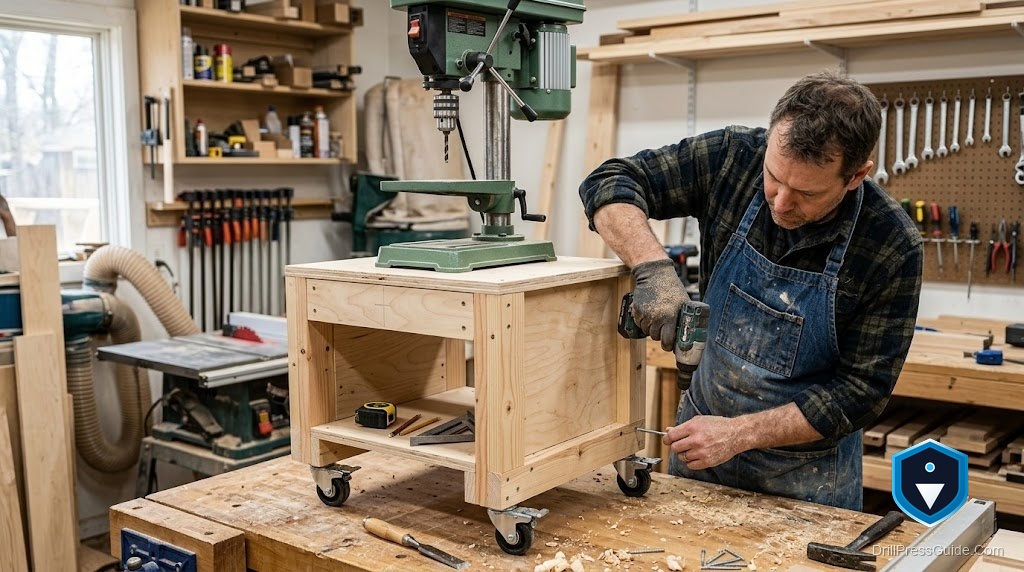
A benchtop drill press does most of its best work at the wrong height, hunched on a bench where you stoop over it, sitting on a surface that may flex just enough to blur an accurate hole. Making it a dedicated stand fixes both problems in an afternoon. You get the machine at a comfortable height and, just as importantly, a rigid base that lets it drill as accurately as it was built to. This is a clear, shop-ready method that keeps rigidity, the thing that actually matters, at the center.
A drill press stand is a shop-built floor stand that a benchtop drill press bolts to, raising it to a comfortable working height on a rigid, stable base. Making one means building a frame that will not rack, giving it a footprint wider than the machine, keeping mass low, fitting a flat solid top, and bolting the machine down square and immovable.
Short answer: build a rigid, braced frame with a footprint wider than the drill press base, keep weight low for stability, fit a thick flat top, and bolt the machine firmly to it. Set the height to your own comfortable working position, level the finished stand, and verify it is solid. Those choices give you both convenience and the steady base accuracy depends on.
Decide height and footprint from your own body
Start with dimensions, because they drive the whole build. Set the height so the chuck and the table sit where you work comfortably while standing, measured from your own stance rather than copied from a plan, since a stand at the wrong height is a daily annoyance. Make the footprint wider than the drill press base in both directions, because the machine is top-heavy and a narrow base invites tipping. Sketch the frame to these numbers and plan a lower shelf into it. Sizing the stand to you and to the machine first means it ends up both comfortable and stable, instead of forcing a compromise later.
Build the frame for rigidity above all
The frame decides whether the finished stand helps or hurts accuracy, so build it to resist racking, the twist that lets a square stand lean under side load. Use dimensional lumber or thick plywood, glue and screw every joint, and add diagonal braces or corner gussets so the structure cannot parallelogram. Keep the legs stout enough not to flex. Test it as you go by shoving the assembled frame, it should stay dead square. This is where to spend your effort, because a rigid, non-racking frame is the single biggest reason a stand lets the machine drill true, while a wobbly frame undoes even the best drill press.
Add mass low and a solid mounting top
Build in a lower shelf, both for storage and, crucially, to carry weight near the floor, since low mass damps vibration and resists tipping, both of which protect accuracy. If the stand stays put, load that shelf or add ballast. Fit a thick, flat top, laminated plywood or a steel plate, sized for the machine’s base and flat enough that the press seats fully without rocking. A rocking machine on a flexy top moves micro-amounts under load, exactly the movement that spoils holes, so make the top solid and true. Low mass plus a solid top turns a rigid frame into a genuinely steady platform.
Mount, level, square, and verify
Bolt the drill press to the top through its base holes so it is held square and immovable, never trusting friction. Stand the stand on the floor, level it, and shim the feet so it does not rock and the machine sits true. Then lean on the machine hard to confirm the whole thing is solid before you rely on it. Square the table to the bit and drill a test hole in scrap to confirm. Because wood moves and bolts settle, re-check level, tightness, and squareness after some use. This closing step, mounting solidly and proving steadiness, is what converts a good build into an accurate, trustworthy machine.
Conclusion
Making a drill press stand is a satisfying afternoon build that pays off every time you use the machine, provided you keep rigidity first. Size it to your own working height with a footprint wider than the press, build a frame that will not rack, add a low shelf for mass and a thick flat top, then bolt the machine down, level the stand, and verify it is rock solid. Re-check it as the wood moves. Done this way, the stand does far more than free your bench: it gives the drill press the steady, square base it needs to drill as accurately as it was designed to.
Frequently asked questions
What height should I make a drill press stand? One that puts the chuck and table at a comfortable working height for you standing. Measure from your own stance rather than copying a plan, since the wrong height becomes a daily annoyance.
How do I keep the stand from tipping? Make the footprint wider than the drill press base in both directions and keep weight low, often with a loaded lower shelf. A top-heavy machine on a narrow base tips easily.
Why is a rigid frame so important? Because any movement of the machine while drilling becomes a wandering or angled hole. A frame that will not rack keeps the machine steady, making the stand part of the accuracy chain.
How should I attach the machine to the stand? Bolt it through its base holes to a thick, flat top so it seats fully and cannot rock. Friction alone lets the machine shift under load and drill inaccurately.
Does adding weight really help? Yes. Mass kept low in the stand damps vibration and resists tipping, both of which protect accuracy, which is why a loaded lower shelf or added ballast is worthwhile.
Do I need to level and re-check it? Yes. Level the finished stand so it does not rock, verify it is solid, then re-check level, bolt tightness, and squareness over time, since wood moves and fasteners settle.
References
- Forest Products Laboratory, wood construction references, fpl.fs.usda.gov
- OSHA, Machine Guarding eTool: Drill Presses, osha.gov


