
Building a DIY Drill Press That Stays Square and Useful
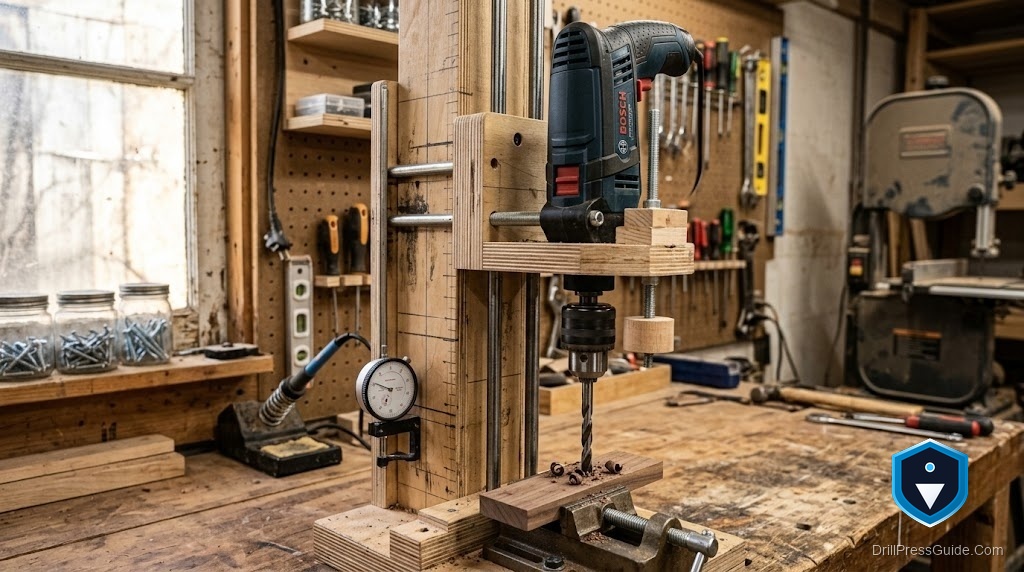
Every so often someone decides to build their own drill press rather than buy one, sometimes to save money, sometimes for the challenge, sometimes to drill in a way no store machine allows. It is a genuinely satisfying project, but it comes with a hard truth: the one thing a drill press absolutely must do is bring the bit straight down, square to the table, without wobble, and that squareness is exactly what is hardest to build. Understanding where a homemade machine tends to lose accuracy is what separates a useful DIY drill press from a frustrating one.
A DIY drill press is a shop-built drilling machine that guides a motor or a handheld drill straight down into the work, typically using a rigid column, a guided carriage or quill, a lever feed, and a flat table. Building one that stays square and useful means engineering rigidity and precise vertical guidance, because those two qualities, far more than the motor, determine whether the machine drills accurate holes.
Short answer: a DIY drill press succeeds only if the vertical guidance is precise and the frame is rigid, so the bit travels straight down with no play and nothing flexes under thrust. If you can achieve tight, wobble-free guidance and a stiff column and table, a homemade machine is genuinely useful; if you cannot, a modest commercial press will out-drill it easily. Be honest about which is true for your build.
The two things that decide everything
A drill press is really just two hard problems: guiding the spindle perfectly straight, and holding everything rigid while it cuts. The guidance, the quill or carriage that moves the bit down, must have almost no play, because any slop there becomes an oversized, angled, or wandering hole. The rigidity, the column and table, must resist the thrust and side forces of drilling without flexing, because flex shows up as the same errors. A commercial machine solves both with a precision-fit quill in a cast iron head on a ground steel column. A DIY build has to solve them with whatever you can fabricate to a similar precision, and that is the real challenge.
Guidance: the make-or-break element
Most homemade drill presses fail at guidance. Sliding a drill down a couple of rods or a loose channel almost always leaves play that ruins accuracy. The better approaches borrow precision from real components: linear rails and bearings, a salvaged quill assembly from an old machine, or precisely fitted guide bushings on hardened rod. Whatever you choose, the test is simple, once assembled, try to wiggle the bit sideways at full extension; if it moves, the machine will drill oversized, angled holes. Prioritize spending your effort and budget here, because no amount of rigidity elsewhere fixes sloppy vertical guidance.
Rigidity: column, table, and base
With guidance solved, rigidity is next. The column must not flex or twist under drilling force, so a substantial steel column or tube anchored solidly beats a light or wooden one. The table must be flat and stay square to the guidance, and it must not deflect when you press the work against it. The base must be heavy and stable so the whole machine does not rock. Weakness anywhere in this chain lets the bit wander, so build the structure as if it will be pushed hard sideways, because in use it will be. A rigid frame around precise guidance is what makes the machine trustworthy.
Power, feed, and safety
The motor is the easy part and the least critical to accuracy; a suitable motor or a sturdy handheld drill provides the spin, matched to a speed appropriate for your bits and materials. The feed, the lever and return spring that lower and raise the spindle, should be smooth and controllable so you can plunge steadily. Safety cannot be an afterthought: guard the belt and any exposed rotating parts, provide a reliable on-off switch within reach, ensure the bit cannot fly out, and make the table capable of clamping the work so nothing spins loose. A homemade machine gets no factory guarding, so you must build it in deliberately.
Conclusion
Building a DIY drill press is a rewarding project, but its success rides almost entirely on two things: precise vertical guidance with no play, and a rigid frame that does not flex under load. Solve those, borrowing precision from linear rails, a salvaged quill, or well-fitted bushings, and build a stiff column, flat square table, and heavy base around them, and you get a machine that drills straight, accurate holes and genuinely earns its place. Fall short on guidance or rigidity and a modest commercial press will beat it every time. Add a controllable feed, an appropriate motor, and deliberate guarding, and a homemade drill press can be both square and truly useful.
Frequently asked questions
Is it worth building a DIY drill press? It can be, if you can achieve precise, play-free vertical guidance and a rigid frame. If you cannot reach that precision, a modest commercial press will drill more accurately for less effort.
What is the hardest part of building one? The vertical guidance. The spindle must travel straight down with almost no play, and achieving that with shop-made parts is what most homemade machines get wrong.
How do I get accurate vertical guidance? Borrow precision from real components: linear rails and bearings, a salvaged quill assembly, or precisely fitted guide bushings on hardened rod. Test by trying to wiggle the bit sideways; any movement means trouble.
Does the motor need to be powerful? The motor is the least critical part for accuracy. A suitable motor or sturdy drill at an appropriate speed is enough; guidance and rigidity determine hole quality, not raw power.
How rigid does the frame need to be? Rigid enough that the column, table, and base do not flex or rock under drilling thrust and side forces. Build it as if it will be pushed hard sideways, because in use it will be.
What about safety on a homemade machine? Build it in deliberately: guard the belt and rotating parts, fit a reliable switch within reach, ensure the bit cannot come loose, and make the table able to clamp the work.
References
- OSHA, Machine Guarding eTool: Drill Presses, osha.gov
- Forest Products Laboratory, machining and construction references, fpl.fs.usda.gov


