
Benchtop Drill Press with Laser: What It Is, Where It Fits, and What to Check
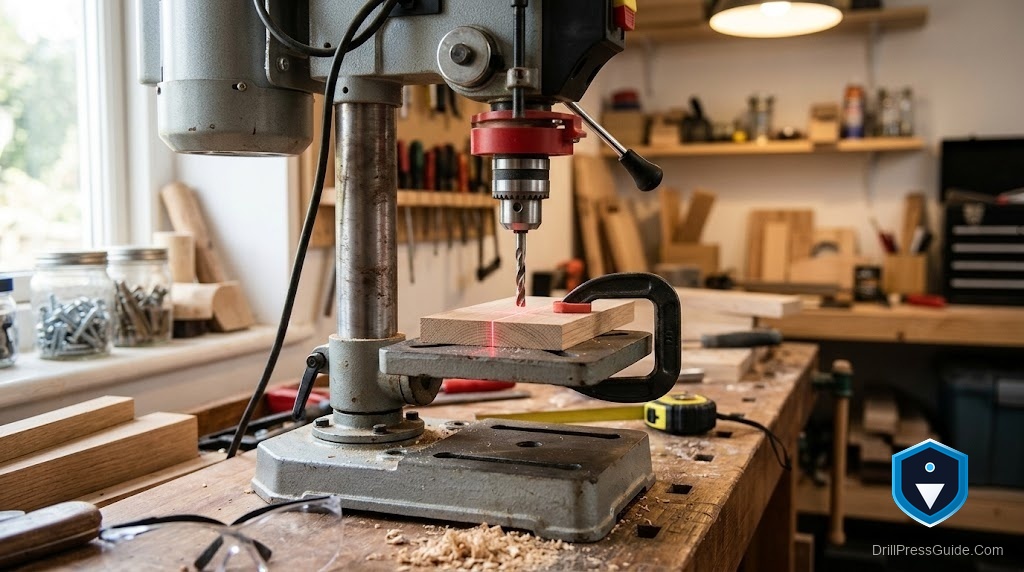
The laser is the feature that sells the machine on the shelf and gets ignored six months later. Walk any tool aisle and the drill presses with a red crosshair projected on the table get picked up first, because it looks like the machine will line up your hole for you. Sometimes it helps. Often it drifts. Understanding which is which before you buy saves you from paying for a light show and skipping the things that actually make a drill press worth owning.
A benchtop drill press with laser is a standard bench-mounted drilling machine that adds one or two laser lines projected down onto the work, meeting at the point where the bit will enter. The idea is a quick visual guide so you can position a workpiece without lowering the bit to check. The laser is a convenience layer on top of an ordinary drill press, not a precision instrument.
Short answer up front. A laser is a nice-to-have, not a reason to buy. Judge a benchtop drill press with a laser on the same things you would judge any drill press: motor, spindle travel, speed control, chuck capacity, and table quality. Treat a well-aligned laser as a small bonus for rough positioning, and never trust it for precise layout over a center punch.
What the laser does well, and what it does not
Honestly, the laser earns its keep for one thing: dropping a workpiece roughly under the bit for non-critical holes, fast, without lowering the quill to eyeball it. For production-style repetitive drilling where a hair of drift does not matter, that speed is real.
Where it falls down is precision and alignment. The two lines have to be adjusted so they actually cross at the bit center, and that adjustment drifts with vibration and use. Many owners find the crosshair creeps out of true and stop trusting it. For any hole that matters, you still mark the spot with a center punch and sink a pilot, because a punched divot guides the bit itself, and no projected line can do that. So the laser is a rough-positioning aid, and it is only as good as its last alignment.
The specs that decide whether the machine is any good
Strip the laser away and look at the machine. Motor size sets how it behaves in dense wood and metal. Spindle travel decides how thick a piece you can drill in one plunge. Speed control, either fixed belt speeds or a variable dial, determines how easily you match RPM to bit size. Chuck capacity, 1/2 inch versus 5/8 inch, sets the largest bit and hole saw you can grip. And the table’s flatness and how easily it raises, lowers, and bevels affects every setup. A machine that nails these is worth owning with or without a laser.
A model that gets the fundamentals right
The WEN 4214T 12-inch variable speed benchtop drill press is a good example of a laser machine where the fundamentals carry the tool, not the light. It has a 5-amp induction motor, mechanical variable speed from 580 to 3200 RPM with a digital readout, a 3-1/8-inch spindle travel, and a 5/8-inch keyed chuck, so it drills a wide range of bit sizes across wood and light metal without a belt change. It also includes both a work light and the laser.
The honest flaws are the ones common to the category. The laser needs occasional adjustment to stay centered, and plenty of owners quietly stop relying on it. At 85 pounds the machine is a two-person lift onto a bench. Who should skip it? Anyone whose work is tiny parts on a cramped bench, because a full 12-inch head is more than they need. For everyone drilling boards and the odd steel bracket, it is a strong pick, and the laser is the least important reason to like it.
Who benefits from the laser at all
The people who get real value from a drill press laser are those doing repetitive, non-critical positioning: drilling a batch of shelves, roughing in pilot holes, production hobby work where speed beats a thousandth of an inch. If your work is layout-critical, cabinet hardware, metal that must line up, anything jig-based, you will punch and pilot every hole regardless, and the laser becomes scenery. Buy the machine for the motor and the table. Enjoy the laser if it happens to stay aligned.
Conclusion
A benchtop drill press with a laser is worth buying when the machine underneath the laser is good, and a waste when the laser is the whole pitch. The red crosshair helps you rough in non-critical holes quickly, and it drifts often enough that no careful worker relies on it for precise layout. The WEN 4214T is a solid example because its motor, variable speed, spindle travel, and chuck make it a genuinely useful machine, with the laser as a small extra. Judge these tools by the fundamentals, keep a center punch on the bench, and you will never be disappointed by a laser that wandered out of true.
Frequently asked questions
Is a laser on a drill press accurate? Only as accurate as its last alignment, and it drifts with use. It is fine for rough positioning but not for precise layout. Use a center punch and pilot hole for holes that matter.
Do I need a drill press with a laser? No. A laser is a convenience, not a necessity. Choose the machine based on motor, spindle travel, speed control, chuck capacity, and table quality, and treat the laser as a bonus.
Can you adjust the laser on a benchtop drill press? Yes, most have adjustable laser modules so the lines cross at the bit center. They need occasional readjustment because vibration moves them out of true.
What is better, a laser or a work light on a drill press? Most owners find the work light more useful day to day, because good light over the bit helps every hole, while the laser only helps rough positioning and needs alignment.
What chuck size should a benchtop drill press with laser have? A 5/8-inch keyed chuck is more versatile than 1/2 inch, because it grips larger bits and hole saws. Match chuck size to the largest bit you expect to use.
Why does my drill press laser not line up with the hole? The laser module has drifted out of alignment, or it was never centered. Adjust the module so the lines cross at the bit tip, and recheck it periodically.
References
- WEN Products, 4214T 12-Inch Variable Speed Drill Press specifications, wenproducts.com
- OSHA, Machine Guarding eTool: Drill Presses, osha.gov


