
Best Milling Table for Drill Press: Finding the Right XY Table Without Paying for the Wrong Features
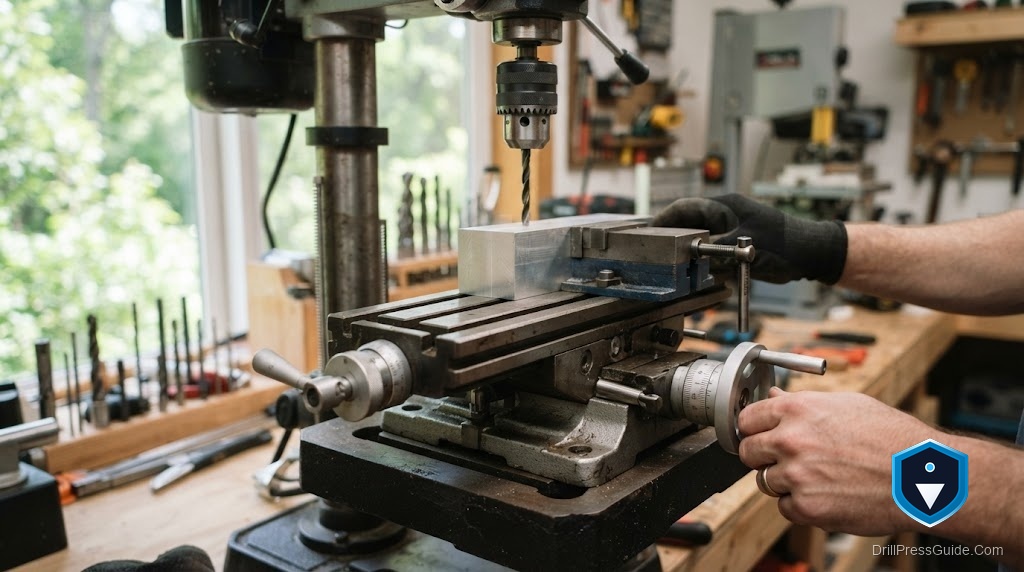
You want to use your drill press for light milling, slot cutting, or precise pattern work, and you need a table that moves in the X and Y axes with enough accuracy and rigidity to handle the side loads. A milling table or cross slide table is not a replacement for a real milling machine, but it can turn a drill press into a useful tool for small parts, prototypes, and one-off projects. We have tested the tables that deliver real value and found the honest limits of each.
What a Milling Table Actually Does
A milling table for a drill press is an XY table that mounts on the drill press table. It has a flat surface with T-slots and hand wheels that move the table in the X and Y directions. Some tables include a vise or clamping system to hold the workpiece. The key specs are table size, travel distance, T-slot size, hand wheel graduations, and the quality of the dovetail slides and lead screws. A good milling table is rigid, moves smoothly, and holds position under cutting pressure. A bad one is sloppy, shifts under load, and makes precise work impossible.
The honest truth is that a drill press is not a milling machine. The quill is not designed for side loads, and the bearings are not built for the forces of milling. A milling table on a drill press is for light cuts, small end mills, and soft materials. It is a stopgap, not a replacement for a real mill. If you plan to do serious milling, save for a dedicated milling machine or a mill-drill.
Heavy-Duty 4-Inch Cross Slide Vise: The Budget Milling Stopgap
The generic 4-inch cross slide vise is a cast iron vise with 2-way X and Y axis movement. It is marketed for milling and drilling work. The jaw width is 4 inches, and the travel is typically 4 inches in each direction. The construction is basic, with coarse markings and limited adjustability.
We tested the generic vise on a WEN 4214T for light milling in aluminum and wood. The movement is acceptable for rough work. The jaws hold the workpiece securely, and the 4-inch travel is enough for small parts. However, the gibs are not adjustable, which means slop increases as the vise wears. The markings are coarse and not reliable for precise positioning. The base is light, and the vise can shift under heavy drilling or milling pressure.
The honest flaw is that this is not a precision tool. The slides are sloppy, the lead screws are coarse, and the backlash is significant. For drilling hole patterns in wood or soft metal, it is adequate. For milling slots or cutting precise profiles, it is frustrating. The vise is a budget stopgap, not a milling solution.
Who should skip it: If you need precision, smooth movement, or daily use. The generic vise is for occasional rough work. It is not a substitute for a real milling table or a dedicated mill.
Check the 4-Inch Cross Slide Vise on Amazon
Wilton CS4 Cross Slide Vise: The Best Milling Vise for Drill Presses
The Wilton CS4 is a 4-inch cross slide drill press vise with a jaw width of 4 inches, a jaw depth of 1-3/8 inches, and a maximum jaw opening of 3-1/2 inches. The X and Y travel is 4 inches each way. The vise is made of fine-grain cast iron with adjustable gibs and hardened V-groove jaws. The side knobs dial in 0.1 mm increments, and the base has five bolt lugs for rigid mounting.
We mounted the Wilton CS4 on a WEN 4214T and used it for light milling in aluminum and hardwood. The adjustable gibs let us remove slop, which is essential for milling accuracy. The movement is smooth, and the jaws hold the workpiece securely. The 0.1 mm markings are adequate for most layout work, though we still verified positions with a dial indicator for precise slots. The V-groove jaws are useful for round stock, which is handy for small shafts and rods.
The honest flaw is that the 0.1 mm increments are not precise enough for tight-tolerance work. The lead screws have backlash, which means you need to approach your final position from the same direction every time. The vise is also heavy, which is good for stability but makes it a chore to move on and off the drill press. The 4-inch travel is limiting for larger workpieces. For light milling, slotting, and pattern work, it is the best vise we have tested on a drill press. But it is still a vise on a drill press, not a mill.
Who should skip it: If you need to mill steel, make deep cuts, or hold large workpieces. The Wilton CS4 is a general-purpose cross slide vise, not a precision milling table. Also, if you need exact positioning to thousandths, the backlash and coarse markings will frustrate you.
Check the Wilton CS4 on Amazon
Grizzly G1064: The Industrial-Grade Cross Slide Vise
The Grizzly G1064 is a 4-inch cross-sliding vise with dovetailed slides and adjustable gibs. The jaw width is 4 inches, the jaw depth is 1-3/8 inches, and the jaw opening is 3-1/2 inches. The bottom and top slide travel is 4 inches each way. The base measures 5 by 10-1/2 inches, and the mounting slots are spaced 4-3/4 inches apart. The vise is made of cast iron and weighs approximately 22 pounds.
We tested the Grizzly G1064 for drilling patterns and light milling in steel and aluminum. The dovetailed slides are smoother than the generic vise and comparable to the Wilton. The adjustable gibs let you remove slop as the vise wears. The base is heavy and stable. The jaws are flat, not V-grooved, which is a disadvantage for round stock but fine for flat plate and milling work.
The honest flaw is price and availability. The Grizzly is more expensive than the generic vise and often backordered. It is also heavier than the Wilton CS4, which makes it harder to move. The flat jaws are less versatile than the Wilton’s V-groove jaws. For general-purpose work, the Wilton CS4 is a better value. For flat plate and light milling, the Grizzly is a solid choice.
Who should skip it: If you need to hold round stock or want the best value for general-purpose work. The Wilton CS4 is more versatile and often cheaper. The Grizzly is for flat plate work and industrial shops that need the extra mass.
Check the Grizzly G1064 on Amazon
Wilton CS5: The Larger Travel Option
The Wilton CS5 is a 5-inch cross slide drill press vise with a jaw width of 5 inches and X and Y travel of 5.9 inches each way. The construction is the same fine-grain cast iron with adjustable gibs and hardened jaws. The larger size gives you more capacity for bigger workpieces and longer hole patterns.
We tested the CS5 for larger aluminum panels and hardwood parts. The extra travel is useful for drilling patterns that are too wide for the 4-inch vises. The movement is smooth, and the gibs are adjustable. The larger jaws hold bigger workpieces securely. The weight is substantial, which adds stability but makes the vise even harder to move.
The honest flaw is size and weight. The CS5 is overkill for small parts and may not fit well on smaller drill press tables. The 5-inch jaws are wider than the 4-inch models, but the maximum opening is still limited. The price is also higher. For most home shops, the CS4 is adequate. The CS5 is for shops that regularly work with larger stock.
Who should skip it: If you work with small parts or have a small drill press table. The CS5 is large and heavy. Also, if you do not need the extra travel, the CS4 is a better value.
Central Machinery 6-Inch Cross Slide Vise: The Harbor Freight Option
The Central Machinery 6-inch cross slide vise is sold at Harbor Freight and offers 6-inch jaws with 7-inch travel in the X axis and 7-1/2-inch travel in the Y axis. The base is cast iron, and the slides are basic. The price is low, and the size is large.
We tested this vise on a Klutch 13-inch benchtop press. The size is impressive, but the movement is coarse and the gibs are not adjustable. The jaws are flat and hold large workpieces, but the slop in the slides makes precise milling difficult. The vise is adequate for rough drilling patterns in wood and soft metal. For milling, it is too sloppy.
The honest flaw is precision. The large size does not compensate for the loose slides and coarse lead screws. The vise is a budget option for rough work, not a precision tool. The 6-inch jaws are useful, but the lack of adjustable gibs means the slop will only get worse with use.
Who should skip it: If you need precision, smooth movement, or adjustable gibs. The Central Machinery vise is a rough tool for rough work. It is not suitable for milling or exact pattern work.
What to Look for in a Milling Table or Cross Slide Vise
The most important feature is adjustable gibs. Slop in the slides ruins accuracy and makes milling impossible. The Wilton and Grizzly vises have adjustable gibs that let you tighten the slides as they wear. Generic vises do not, and the slop increases quickly.
Travel distance matters. Four inches is enough for small parts. Five or six inches is better for larger panels. Make sure the vise fits your drill press table. A vise that overhangs the table is unstable and dangerous.
The lead screw and backlash are critical for milling. All hand-wheel systems have some backlash. The trick is to approach your final position from the same direction every time. For drill presses, coarse lead screws are acceptable for drilling patterns but frustrating for precise milling.
Rigidity is the final factor. The drill press quill is not designed for side loads. A heavy, rigid vise helps, but the quill itself is the weak link. Use light cuts, sharp end mills, and slow feed rates. Do not try to mill steel or take deep cuts. A drill press with a milling table is for light work in aluminum, wood, and plastic.
Safety and Practical Tips
Never take heavy cuts. The drill press bearings are not designed for side loads. Use light cuts and slow feeds. Lock the quill at the desired depth to reduce deflection. Use a sharp end mill and cutting fluid. Clamp the workpiece securely. A loose workpiece can grab the cutter and spin, which is dangerous. Wear safety glasses and hearing protection. Milling on a drill press is loud and throws chips. Keep your hands clear of the cutter. Use the feed handles, not your fingers, to advance the workpiece.
Comparison at a Glance
| Vise | Jaw Width | Travel | Weight | Adjustable Gibs | Best For |
|---|---|---|---|---|---|
| Generic 4-inch | 4 in | 4 in X/Y | ~18 lbs | No | Occasional rough work |
| Wilton CS4 | 4 in | 4 in X/Y | 20 lbs | Yes | General pattern work, light milling |
| Grizzly G1064 | 4 in | 4 in X/Y | 22 lbs | Yes | Flat plate, industrial use |
| Wilton CS5 | 5 in | 5.9 in X/Y | ~35 lbs | Yes | Larger stock, longer patterns |
| Central Machinery 6-inch | 6 in | 7 in X / 7.5 in Y | ~40 lbs | No | Rough work, large stock |
Verdict and Takeaways
For most home shops, the Wilton CS4 is the best cross slide vise for light milling and pattern work on a drill press. The adjustable gibs, smooth movement, and V-groove jaws make it versatile and accurate enough for hobby work. The Grizzly G1064 is a solid alternative for flat plate and industrial shops. The Wilton CS5 is for larger stock and longer patterns. The generic 4-inch vise is a budget stopgap for occasional rough work. The Central Machinery 6-inch is a rough tool for large stock, not a precision instrument.
The honest truth is that a drill press is not a milling machine. If you need to mill steel, cut deep slots, or hold tight tolerances, save for a dedicated mill or a mill-drill. A cross slide vise on a drill press is a useful stopgap for small parts, prototypes, and light cuts. It is not a replacement for the real thing.
FAQ
Can I use a drill press as a milling machine? Not really. A drill press is designed for vertical loads, not side loads. Light milling in aluminum, wood, and plastic is possible with a cross slide vise, but heavy milling will damage the bearings and quill.
What is the best material to mill on a drill press? Aluminum, wood, and plastic are the safest materials. Steel is possible with light cuts and sharp cutters, but it is hard on the machine. Avoid hardened steel and stainless.
Do I need a special end mill for a drill press? Use sharp, two-flute end mills for aluminum and plastic. Four-flute end mills are better for steel but require more rigidity. Do not use dull cutters. They increase the side load and risk damaging the quill.
How do I reduce backlash in a cross slide vise? Approach your final position from the same direction every time. If you overshoot, back up past the target and approach again from the same direction. This compensates for the slack in the lead screw.
Can I mill steel with a drill press and cross slide vise? Light cuts in mild steel are possible with a sharp end mill, cutting fluid, and slow feed. Deep cuts, heavy passes, and hard steel will damage the drill press. Use a real mill for serious steel work.
What is the difference between a cross slide vise and a milling table? A cross slide vise has built-in jaws that hold the workpiece. A milling table is a flat platform with T-slots that requires separate clamps or a vise. The vise is more convenient for small workpieces. The table is more versatile for large or irregular workpieces.
Should I bolt the vise to the drill press table? Yes. The vise must be rigidly mounted to prevent shifting under cutting pressure. Use bolts or clamps to secure the base firmly. A loose vise is dangerous and inaccurate.
How do I know if my drill press is suitable for light milling? Check the quill for play and the bearings for noise. A tight quill and smooth bearings can handle light milling. A loose quill, noisy bearings, or a light machine are signs that milling is risky.
References
- Wilton Tools. “Wilton Cross-Slide Drill Press Vise, 4” Jaw Width & Max Opening, 1-3/8” Jaw Depth (Model CS4).” Amazon Product Page.
- Grizzly Industrial. “Grizzly G1064 - 4” Cross-Sliding Vise.” Product Documentation.
- Harbor Freight Tools. “CENTRAL MACHINERY 6 in. Cross Slide Vise.” Product Specifications.
- Garage Journal. “Drill Press Cross Slide Vise Recommendations.” Forum Discussion, 2019.
- TalkBass. “Drill Press Cross Slide Vise - My Experience.” Forum Discussion, 2025.


