
Finding the Right Tabletop Drill Press Without Paying for the Wrong Features
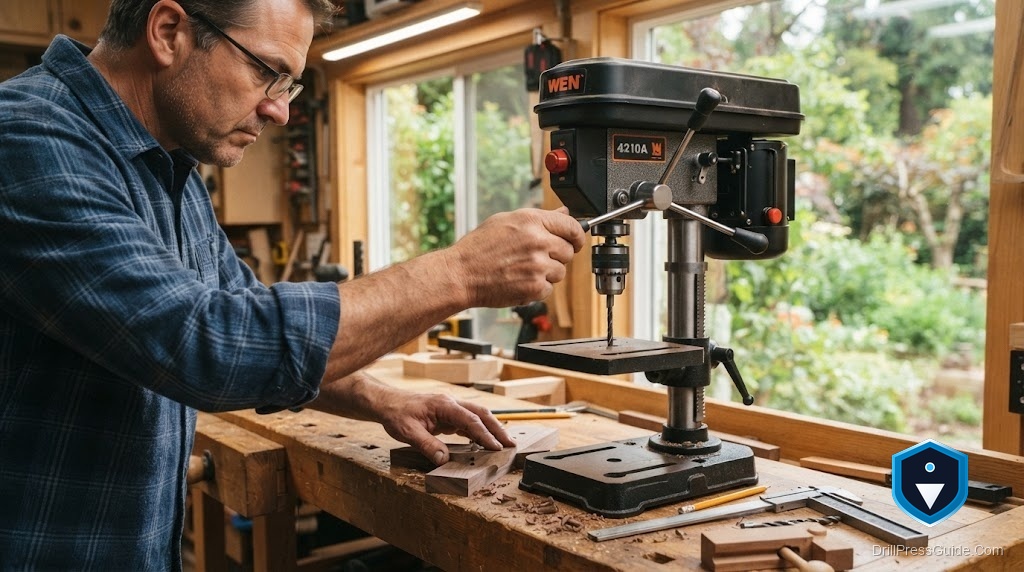
A tabletop drill press sounds like the perfect compromise. It gives you the accuracy of a stationary machine without eating up floor space. But walk into a store or browse online, and the range is overwhelming. Eight-inch swings, ten-inch swings, laser guides, variable speed, digital readouts. Some of those features earn their keep. Others are just marketing shine that inflates the price without changing how the machine actually works.
I have used benchtop presses in cramped garage shops and in dedicated woodworking spaces. The good ones become the most reliable tool in the room. The bad ones wobble, scream, and make you wish you had stuck with a hand drill. Here is how to tell the difference before you spend money.
What Tabletop Means in Real Terms
Tabletop and benchtop are the same thing. The machine sits on a workbench, stand, or cabinet instead of bolting to the floor. The motor is smaller, the column is shorter, and the swing (the distance from the spindle center to the column) is usually eight to twelve inches. That limits the maximum workpiece width you can drill, but for most home projects, ten inches is plenty.
The real constraint is height. A benchtop press might be thirty to thirty-six inches tall. That means you cannot drill through thick stock in a single pass if the bit is long and the table is raised. You learn to work around it, but it is worth knowing before you buy.
The Motor: More Is Not Always More
Benchtop presses run motors from one-third to two-thirds horsepower. The key is not the horsepower number on the sticker. It is how the motor handles load. A cheap motor with a high horsepower rating will still bog down when you push a two-inch Forstner bit into maple. A well-built motor with a lower rating will keep turning because the torque is there.
Induction motors are generally smoother and quieter than universal motors. They cost a little more, but they last longer and cause less vibration. If you are drilling metal, look for a motor with enough low-end torque to keep the bit from grabbing. Variable speed helps here, but it is not the only factor.
Speed Range Matters More Than Speed Count
A five-speed press with a stepped pulley is the traditional setup. You open the belt cover, move the belt to a different pair of pulley steps, and close it up. It is simple, reliable, and hard to break. A variable-speed press with a mechanical dial or electronic control lets you adjust on the fly without opening the cover. That convenience is real, but it adds complexity and cost.
For woodworking, a top speed of three thousand RPM or higher is useful for small bits and pilot holes. For metal, you want slow speeds down to five hundred RPM or lower. A press that spans from roughly five hundred to three thousand RPM covers most home shop work. If you only drill wood, the low end matters less. If you drill steel, it matters a lot.
The Table: Where Cheap Presses Fall Apart
The table is the most underrated part of a drill press. A small, thin table flexes under pressure. It also limits the size of the workpiece you can support. Look for a table that is at least seven inches square, made of cast iron or thick steel, and tilts left and right for angled drilling. A table that only tilts one way is frustrating when you need the opposite angle.
Some tables have slots for hold-downs or clamps. That is useful. Some have a removable insert so you can drill through the workpiece without hitting the table surface. That is also useful. A table with neither is not a dealbreaker, but it is a convenience you will miss.
Laser Guides and Lights: Nice, Not Necessary
A laser crosshair that projects onto the workpiece sounds useful. In practice, it helps you place the bit over a mark if the mark is dark and the shop is dim. In bright light, the laser is invisible. And it needs calibration. If the laser is off by an eighth of an inch, it is worse than useless because it trains you to trust the wrong spot.
A work light is genuinely helpful. It shines on the work area from above, making it easier to see layout lines and bit engagement. If a press has a light but no laser, that is a better deal in my book. If it has both, treat the laser as a bonus and the light as the real feature.
The Chuck and Spindle Taper
Most benchtop presses come with a keyed chuck, usually half-inch capacity. Keyed chucks grip more securely than keyless chucks, especially at higher torque. For a drill press, that is what you want. A half-inch chuck handles bits up to that diameter and accepts standard shank sizes down to one-sixteenth inch.
The spindle taper is usually a Morse taper, most commonly MT2 in this class. That is a good thing because it means you can use standard drill press accessories like mortising attachments, sanding drums, and shapers. A press with a non-standard taper limits you to the accessories the manufacturer sells.
Three Presses That Earn Their Bench Space
WEN 4208T 8-Inch 5-Speed Benchtop Drill Press
This is the honest entry point. It has an eight-inch swing, a two-inch spindle travel, and five speeds from seven hundred forty to three thousand one hundred forty RPM. The motor is a 2.3-amp induction type, which is modest but adequate for light to medium work. The table is six and a half inches square, tilts forty-five degrees, and the base is cast iron to keep the machine from walking. The build is straightforward, the price is fair, and it does not pretend to be more than it is. WEN 4208T on Amazon
The flaw is the limited capacity. The eight-inch swing means a sixteen-inch maximum workpiece width, and the two-inch spindle travel is tight for deep holes. If you routinely drill thick stock or large panels, you will outgrow it. It is best for a hobbyist who needs accurate holes in smaller workpieces and does not want to spend much to get there.
SKIL 3320-01 10-Inch 5-Speed Drill Press with Laser
The SKIL steps up to a ten-inch swing and a 3.2-amp motor, which


