
The Best Drill Press Table: Upgrades That Transform a Bare Cast Top
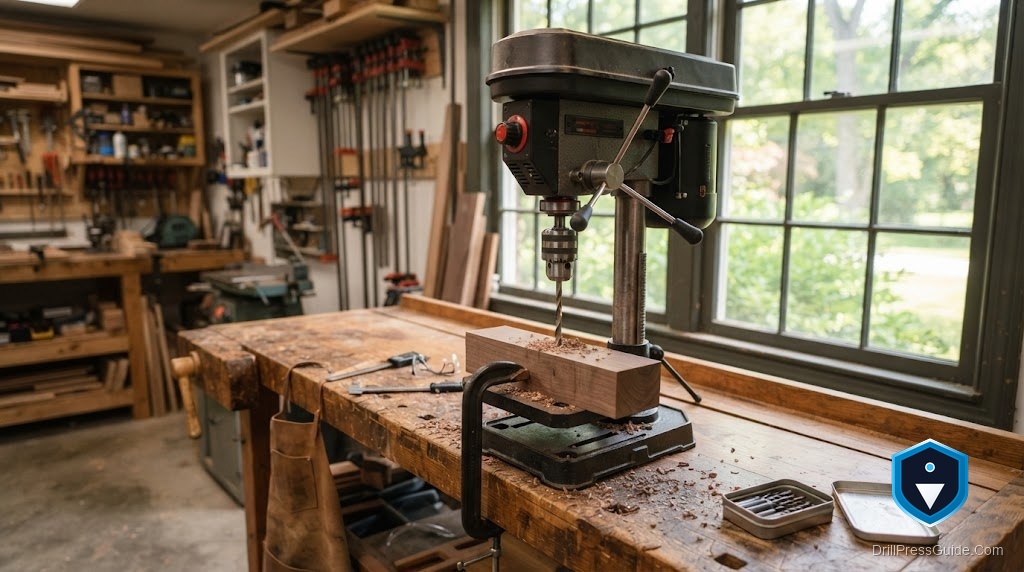
The stock table that comes on almost every drill press is a small slab of cast iron with a hole in the middle, and it is the single biggest thing holding your machine back. It offers no fence, no way to back up a cut against blowout, and barely any surface to support a workpiece. Adding a real table is the cheapest upgrade that changes how a drill press works day to day, and the best drill press table is the one that gives you a fence, support, and hold-downs without introducing flaws of its own. This guide covers the picks and the honest tradeoffs.
The best drill press table is an auxiliary top, usually a flat panel with a fence and slots for hold-downs, that mounts over the stock cast-iron table to add support, backing against blowout, and repeatable positioning. The right one fits your press, adds a usable fence, and resists wear.
The short answer: for most users a ready-made table with an aluminum or hardwood fence and T-slots is the best upgrade, giving blowout backing and a repeatable stop at a modest price. A shop-built table is the cheapest route if you want to customize, and the picks below cover both, with the flaw of each spelled out.
What a table actually adds
The value of a dedicated table is concrete. First, backing: a flat wooden or panel surface under the workpiece supports the exit side so the bit does not blow out a ragged hole when it breaks through, which the bare cast table cannot do. Second, a fence: a straight edge to register work against turns the press into a repeat-drilling station for rows of identical holes. Third, hold-downs: T-slots let you clamp work securely for safe, accurate drilling. Fourth, a replaceable insert or sacrificial center so you can drill into the surface without ruining it. A good table delivers all four; a poor one delivers a fence but wears out fast or does not stay flat.
The picks
Best ready-made all-around: Fulton drill press table with aluminum fence. The Fulton 15 by 24-inch table drops onto most presses and adds a wide MDF-laminate top, an adjustable aluminum L fence, and hold-down slots, ready to use out of the box. Its honest flaw is the MDF core, which dents under heavy clamping and swells if it gets wet, so treat the top as a wear item to replace eventually. Who should skip it: heavy metal shops that would batter the MDF; they want a harder surface.
Best accessory kit: POWERTEC 71539 table kit. The POWERTEC 71539 drill press table kit bundles a table with a fence and clamping accessories, a complete package for outfitting a press at once. Its honest flaw is that, like most panel tables, the surface is a wear item and the fence, while functional, is basic. Who should skip it: anyone who already has a good top and only needs a fence.
Best fence-only upgrade: POWERTEC 24-inch fence set. If your existing table is fine and you only lack a fence, the POWERTEC drill press fence set adds a straight, adjustable fence with stops for a modest outlay. Its honest flaw is that it is only a fence, adding no larger support surface or replaceable insert. Who should skip it: anyone whose stock table is too small to benefit; they need a full top.
The shop-built alternative
Worth naming plainly: the cheapest and most customizable table is one you build. A flat panel of plywood or MDF, a hardwood or aluminum fence, and a few T-track pieces make a table tailored exactly to your press, with a sacrificial center you replace freely. Its honest flaw is the time and the need for basic woodworking to get it flat and square, and a home-built fence may not be as precise as a machined one. But for customizing to a specific machine or saving money, a shop-built table is often the best answer, and many woodworkers never buy a commercial one.
How the picks compare
Lined up, the choice depends on what you already have. The Fulton table is the best single purchase for someone starting from a bare cast top, delivering surface, fence, and hold-downs together, with the MDF wear caveat. The POWERTEC kit is the all-in-one alternative for outfitting a press at once. The POWERTEC fence set is the targeted fix when only a fence is missing. And a shop-built table beats all of them on cost and customization if you have the time and basic skills. All of them, commercial or built, exist to add the fence, backing, and hold-downs the stock table lacks, which is the entire point.
Bottom line
The best drill press table is the one that adds a fence, blowout backing, and hold-downs to fit your press and your work, and for most people a ready-made table like the Fulton delivers that at a modest price, with the honest caveat that an MDF top is a wear item. Buy the fence set if you only lack a fence, the kit to outfit at once, or build your own to customize and save. Whichever you choose, adding a real table is the upgrade that most changes how usefully a drill press works.
- A real table adds four things the stock top lacks: support, blowout backing, a fence, and hold-downs.
- The Fulton table is the best single upgrade from a bare cast top, with an MDF wear caveat.
- Buy the fence set if only a fence is missing; the kit to outfit at once.
- A shop-built table wins on cost and customization if you have the time and basic skills.
The bare cast top is the bottleneck. A table with a fence and backing is the cheapest fix that transforms the machine.
Frequently asked questions
What is the best drill press table? For most users, a ready-made auxiliary table with an aluminum or hardwood fence and hold-down slots, such as the Fulton 15 by 24-inch top. It adds support, blowout backing, and a repeatable fence at a modest price. A shop-built table is the cheapest custom route.
Why add a table to a drill press? The stock cast-iron top has no fence, no way to back up a cut against blowout, and little support surface. A dedicated table adds a fence for repeatable holes, backing to prevent blowout, hold-downs for safe clamping, and a replaceable center.
Are MDF drill press tables any good? They work well and are flat and affordable, but MDF dents under heavy clamping and swells if it gets wet, so treat the top as a wear item to replace over time. For heavy metal work, a harder surface lasts longer.
Can I build my own drill press table? Yes, and it is often the cheapest, most customizable option. A flat plywood or MDF panel, a hardwood or aluminum fence, and some T-track make a table tailored to your press. It takes time and basic woodworking to get flat and square.
Do I need a fence on my drill press table? A fence is what turns the press into a repeat-drilling station, letting you register work for rows of identical holes and drill accurately. It is one of the most useful features a table adds, so a table with a fence is worth prioritizing.
Will a table fit my drill press? Most auxiliary tables mount over the existing cast-iron table using its slots or clamps and fit a wide range of presses, but check the mounting method and your table’s size before buying. A shop-built table can be made to fit any machine exactly.
References
- WOOD Magazine, drill press tables reviewed: https://www.woodmagazine.com/woodworking-tools/reviews/drill/drill-press-tables
- Fine Woodworking, drill press setup and accessories: https://images.finewoodworking.com/app/uploads/2020/01/22111726/drill-bit-speed-chart.pdf
- OSHA, machine guarding and point-of-operation safety: https://www.osha.gov/machine-guarding


