
Metal Drill Press Tooling and Accessories That Protect Finish and Accuracy
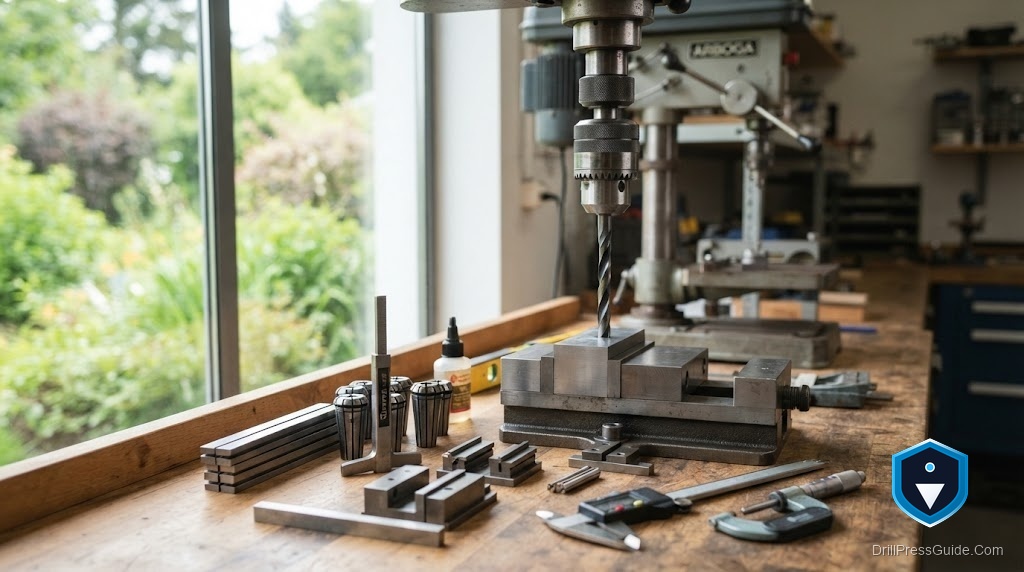
Most people spend everything on the drill press and nothing on what goes around it, then wonder why their steel holes wander, their parts spin, and their bits die young. The truth I keep running into is plainer than that: a mid-range press with the right metal drill press tooling and accessories out-drills a premium machine with a bare table. The motor rarely decides the outcome. The vise, the bits, and the fluid do.
Metal drill press tooling and accessories are the cutting tools and add-ons that turn a bare press into a metalworking setup: the drill bits themselves, the workholding that clamps parts, and the aids like cutting fluid and depth stops that protect the finish and your fingers. On metal, they matter more than they do on wood, because steel is unforgiving of heat and movement.
The short version: buy a real drill press vise, run cobalt bits in anything ferrous, keep cutting fluid at the machine, and add a cross-slide vise only if you understand its limits. That handful of items fixes almost every complaint people have about drilling metal.
Bits: match the metal, not the marketing
The bit is where accuracy and finish start. For mild steel and aluminum, standard high-speed steel with a proper split point works. For stainless and tool steel, step up to cobalt, which keeps cutting when cheaper bits glaze over and start rubbing.
A cobalt M35 drill bit set covers the common sizes and holds an edge in stainless far better than black-oxide HSS. Its honest drawback is that cobalt is more brittle, so it chips if you let the workpiece flex or the bit chatter, which circles back to clamping. Skip cobalt if you only ever drill mild steel and aluminum, where good HSS is cheaper and tough enough.
Whatever you run, a 135-degree split point starts without a center punch dance, and a stubby screw-machine bit wanders far less than a long jobber bit in metal.
Workholding: the accessory that earns its place first
If you buy one thing before anything else, buy a drill press vise. Metal grabs. A bit that catches at breakthrough will rip an unclamped part loose and spin it into a blade, and that is the injury that sends people to the emergency room. A vise bolted to the table removes that risk and, as a bonus, keeps the hole round and on-center because the part cannot creep.
For round stock, a V-block cradles the bar so the bit does not roll off the crown. For repeat holes at the same spot, a fence clamped to the table gives you a repeatable stop. None of this is glamorous, and all of it is the difference between clean parts and a scary afternoon.
The cross-slide vise, and its honest limits
A cross-slide (compound) vise moves the workpiece in two axes under the spindle with leadscrews, which tempts people into thinking a drill press becomes a milling machine. It does not, and it is important to say so plainly.
A cross-slide compound vise is genuinely useful for precise hole positioning, light spot-facing, and tiny cleanup cuts, and it makes repeatable layouts easier. Its real flaw is that a drill press spindle and its bearings are built for downward thrust, not the sideways load of milling, so any real side cutting risks bending the quill and ruining the bearings. Use it to position and to take feather-light cuts. Skip it entirely if what you actually want is a mill, because pushing a press into milling is how you kill the press. Against a plain vise, the cross-slide wins on positioning and loses on simplicity and rigidity.
Cutting fluid and chip control: cheap, essential
Cutting fluid is the least expensive accessory that matters and the one most beginners skip. It carries heat away from the edge, extends bit life, and leaves a cleaner wall on steel and stainless. A can at the machine pays for itself in bits saved. Use it on every ferrous hole; aluminum can go dry if you clear chips often.
Chips themselves are a hazard and a finish-wrecker. Long steel curls are razor sharp and will pack into a hole and score the wall. Clear them with a brush, never a bare hand, and back the bit out on deep holes to break the chip. A depth stop set correctly keeps you from punching into the table and protects both the bit tip and the table surface.
The verdict
Metal drill press tooling and accessories are not a wish list to work through slowly. The order is clear: a real vise first, cobalt bits for ferrous work, cutting fluid always, and a cross-slide only if you respect what it cannot do. A cross-slide vise flatters a press into looking like a mill, and that is exactly the trap to avoid. Spend here before you spend on a bigger motor.
- Buy the vise before anything else; unclamped metal is the top injury risk on a press.
- Run cobalt bits in stainless and tool steel, plain HSS in mild steel and aluminum.
- Keep cutting fluid at the machine and use it on every ferrous hole.
- Treat a cross-slide vise as a positioner, not a milling table.
Get the accessories right and the press you already own will surprise you.
Frequently asked questions
What accessories does a metal drill press actually need? A drill press vise, a set of quality bits matched to your metals, cutting fluid, and a depth stop cover the essentials. A V-block for round stock and a cross-slide vise for positioning are useful next steps.
What bits are best for drilling metal on a drill press? Cobalt (M35 or M42) for stainless and tool steel, standard HSS for mild steel and aluminum. A 135-degree split point starts cleanly, and stubby screw-machine bits wander less than long jobber bits.
Can I mill metal with a cross-slide vise on a drill press? Only the lightest cleanup cuts. A drill press spindle is built for downward thrust, not sideways milling loads, so real side cutting risks bending the quill and destroying the bearings. For milling, buy a mill.
Do I really need cutting fluid? On steel and stainless, yes. It carries heat away, extends bit life, and improves the hole wall. Aluminum can be drilled dry if you clear chips often, though a little fluid still helps.
Why do my metal holes come out oval or off-center? Usually the workpiece moved or the bit walked at the start. Clamp the part in a vise, use a center punch or split-point bit, and start at the correct low speed for the metal.
How much horsepower do I need to drill steel? Most benchtop presses have enough power for typical steel holes. Bit quality, correct low speed, steady feed, and fluid matter far more than extra horsepower for the sizes home shops drill.
References
- Norseman Drill and Tool, drilling feeds and speeds chart: http://www.norsemandrill.com/feeds-speeds-drill.php
- Carbide Depot, drill speeds and feeds formulas: https://www.carbidedepot.com/formulas-drills-speeds.htm
- OSHA, machine guarding and point-of-operation safety: https://www.osha.gov/machine-guarding


