A Practical Guide to Drill Press Accessories for Woodworking
The drill press that came out of the box is a hole-making machine. With a handful of accessories, the same press becomes a joinery tool, a sanding station, and a repeat-drilling jig that turns out identical parts all afternoon. Woodworkers who feel stuck with a basic press usually just have not added the three or four things that unlock it, and most of them cost little.
Drill press accessories for woodworking are the tables, fences, bits, and sanding attachments that expand a press beyond plain drilling into joinery, repeatable holes, and edge shaping. They are what make the machine earn its bench space.
The short answer: an auxiliary table with a fence does the most, the right bits (brad point and Forstner) do the next most, and a drum sander kit turns the press into a spindle sander. Add them in that order and the press transforms.
The table and fence come first
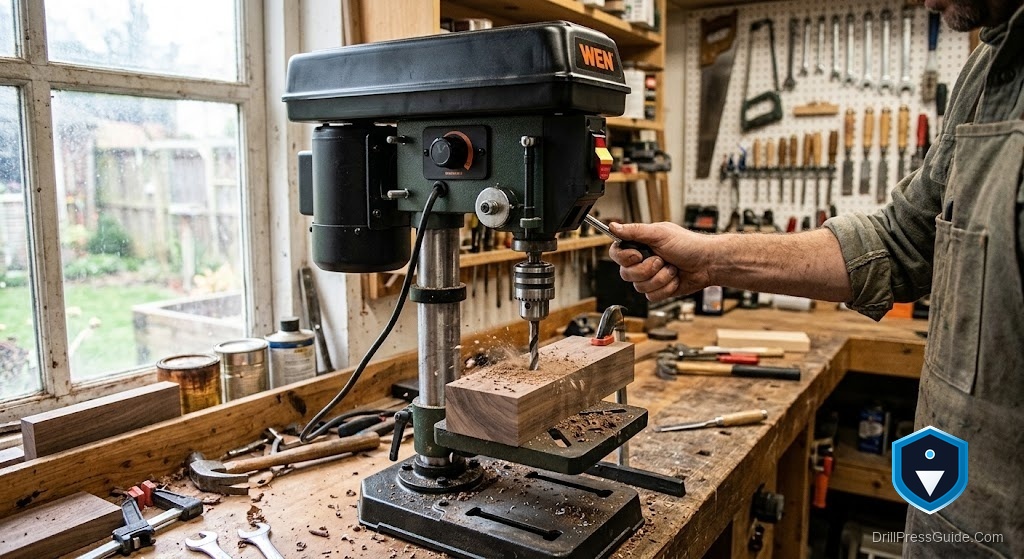
The stock cast-iron table is small, has an open center, and has nothing to register a workpiece against. An auxiliary wood table with a fence fixes all three at once. It gives a flat sacrificial surface that backs up the exit to prevent blowout, a fence to set consistent distance from the edge, and stop blocks for repeatable hole positions.
This single upgrade changes more than any other. Drilling a row of evenly spaced shelf-pin holes goes from fussy measuring to indexing the board against a stop, and every hole lands identical. Many woodworkers build their own from plywood, which is a fine weekend project.
Bits made for wood
Wood cuts cleanest with bits designed for it. Brad-point bits have a center spur that starts exactly on the mark and slices the rim fibers for a crisp hole, ideal for dowels and shelf pins. Forstner bits cut flat-bottomed holes with clean walls and handle overlapping and angled holes a twist bit cannot. A Forstner bit set with carbide tips covers the sizes most furniture and cabinet work needs.
The caution with Forstner bits is speed: large ones scorch if run fast, so slow the press down for anything over an inch. That is a technique fix, not a reason to avoid them; a slow Forstner bit gives the cleanest hole in woodworking.
Sanding and shaping attachments
A drum sander kit chucks into the press and turns it into a spindle sander for smoothing curves and inside edges. With the table’s insert opening, the drum can extend below the surface for full-length sanding. It is one of the most useful and least expensive ways to get more from a press.
The limitation to know is speed and dust. Drums run best at moderate speeds, and a press has no dust collection, so sanding creates a mess and calls for a mask and eye protection. For occasional shaping, though, it saves buying a dedicated machine.
Workholding and safety for wood
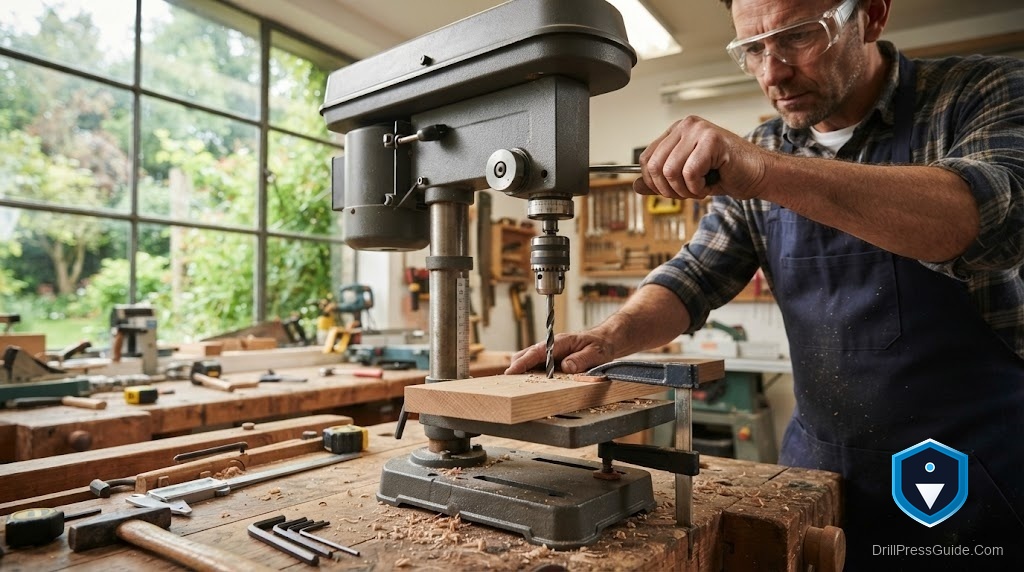
Wood can spin just like metal when a large bit grabs, so a hold-down clamp or a fence with a stop keeps hands clear and parts still, especially with big Forstner bits and drum sanders. A quick-release hold-down or a simple toggle clamp on the auxiliary table makes this effortless.
Eye protection is essential, and a dust mask matters once you start sanding. Keep sleeves clear of the rotating chuck. These habits cost nothing and prevent the accidents that woodworking presses cause most.
The verdict
The accessories that unlock a woodworking drill press are a table with a fence, wood-specific bits, and a sanding drum, roughly in that order of impact. The table alone turns the press into a precision, repeatable tool; the bits deliver clean holes; the drum adds a whole second function. Start with the table and fence, because everything else works better once the press can register and back up a workpiece.
Carry these forward:
- An auxiliary table with a fence is the highest-impact woodworking upgrade.
- Brad-point bits place holes; Forstner bits cut clean flat bottoms.
- Slow the press for large Forstner bits to avoid scorching.
- A drum sander kit adds spindle sanding for little money.
Frequently asked questions
What are the most useful drill press accessories for woodworking? An auxiliary table with a fence, brad-point and Forstner bits, and a drum sander kit. The table with a fence changes the most by enabling backing and repeatable holes.
Do I need a special table for my drill press? A wood auxiliary table with a fence greatly improves accuracy and prevents blowout. Many woodworkers build their own from plywood as a simple project.
What bits are best for wood on a drill press? Brad-point bits for accurate small to medium holes and Forstner bits for flat-bottomed, large, or angled holes. Run large Forstner bits slowly.
Can I sand on a drill press? Yes, with a drum sander kit it becomes a spindle sander for curves and edges. Wear a dust mask, since a press has no dust collection.
How do I drill evenly spaced holes? Use a fence and a stop block on an auxiliary table. Index the workpiece against them and every hole lands in the same position.
Why is my large Forstner bit burning the wood? Too much speed. Large Forstner bits need a slow spindle speed, around 250 to 500 RPM, to avoid scorching the walls.
References
- Fine Woodworking, Drill Press Speed Chart: https://images.finewoodworking.com/app/uploads/2020/01/22111726/drill-bit-speed-chart.pdf
- WOOD Magazine, Wise Buys: Drill-Press Tables: https://www.woodmagazine.com/woodworking-tools/reviews/drill/drill-press-tables