Drill Press Accessories for Metal: The Setup Details That Change the Result
Most people spend their whole budget on the drill press and nothing on the accessories, then wonder why their metal holes wander and their parts spin. The truth is that a mid-range press with the right accessories out-drills a premium press with none. For metalwork especially, a few well-chosen add-ons change the results more than another hundred watts of motor ever will.
Drill press accessories for metal are the vises, bits, and fixtures that let a press hold metal securely and drill it accurately, from clamping vises and cross-slide tables to cobalt bits and cutting fluid. They turn a bare press into a metalworking station.
The short answer: prioritize workholding first (a solid vise or clamps), then the right bits (cobalt for hard metal), then positioning aids like a cross-slide vise. Safety gear is not optional. Buy in that order and each addition earns its place.
Workholding comes before everything
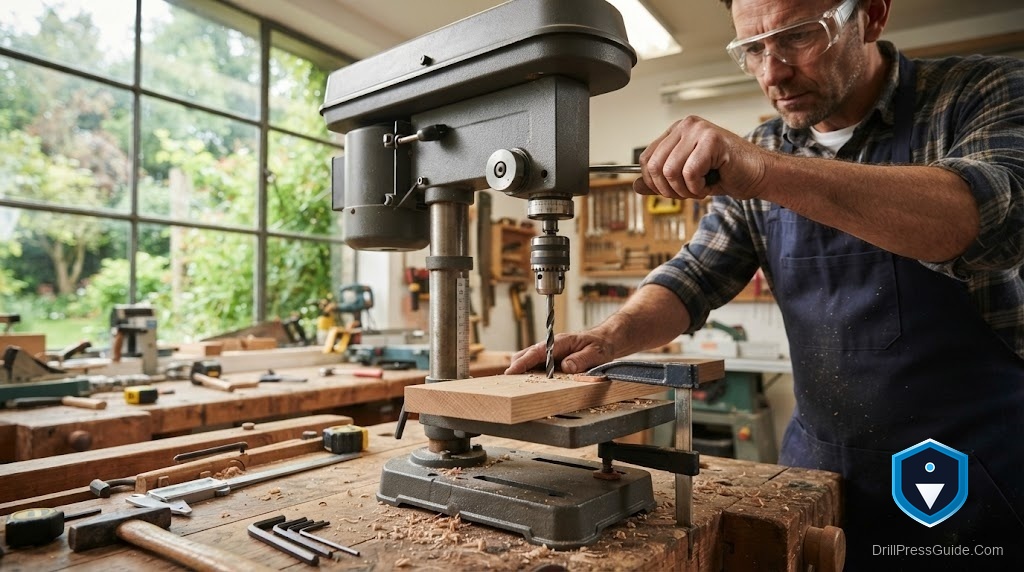
The accessory that changes metal drilling most is the one that holds the work still. Metal grabs hard at breakthrough, and an unclamped part spins into a hazard while it ruins the hole. A proper drill press vise with serrated jaws, bolted to the table, is the first purchase. Table clamps and step blocks handle odd shapes a vise cannot grip.
Everything downstream depends on this. The best bit at the perfect speed still cuts a triangular hole if the work can move. If you buy one accessory for metal, buy the thing that clamps.
Positioning: the cross-slide vise
Once the work is held, the next upgrade is control over where the hole lands. A cross-slide compound vise bolts to the table and moves the work in X and Y with crank handles, so you can space a row of holes precisely or dial in an exact center. Its cast-iron body and serrated steel jaws clamp aluminum, copper, and steel firmly.
The honest flaw is backlash in the feed screws, so it is a positioning tool, not a milling table; approach each hole from one direction to take up the play. Anyone hoping to mill with it will be let down, but for accurate hole placement it is a genuine step up over eyeballing.
Bits and fluid do the cutting
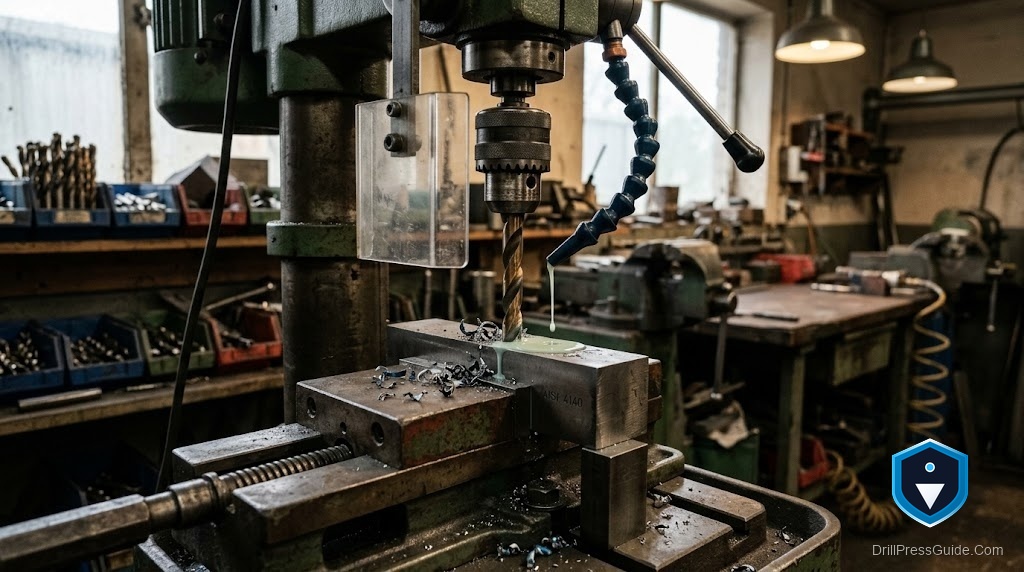
Metal punishes the wrong bit. Plain HSS handles mild steel, aluminum, and brass, but stainless, hardened steel, and cast iron demand cobalt. A cobalt M35 twist drill set holds its edge in the heat that glazes standard bits, and a 135-degree split point resists walking off the mark. Add a center punch so every hole starts true, and a step bit for clean holes in thin sheet.
Cutting fluid is the cheapest accessory that matters. It carries heat away, extends bit life, and improves the finish on steel and stainless. Keep a can at the machine and use it on every ferrous hole.
The small stuff that adds up
A few inexpensive items round out a metal setup. A machinist’s square and an edge finder help you locate holes. A wire brush clears hot chips safely instead of a bare hand. A deburring tool cleans hole edges. And a set of quality clamps means you are never tempted to hold a part by hand. None of these are glamorous, and all of them show up in the quality of the finished hole.
Safety gear belongs on this list, not as an afterthought. Eye protection is mandatory around flying metal chips, and rolled sleeves and no gloves near the rotating chuck prevent the accidents that hurt most.
The verdict
The accessories that transform metal drilling are humble ones: a vise that clamps hard, cobalt bits, cutting fluid, and a cross-slide vise for placement. Buy workholding first, cutting tools second, and positioning aids third, and a modest press becomes a capable metal machine. Skip the vise to save money and every other accessory underperforms, because nothing works when the part can move.
Worth carrying forward:
- Workholding is the first and most important metal accessory.
- A cross-slide vise places holes precisely but is not a milling table.
- Cobalt bits and cutting fluid are what survive hard metal.
- Eye protection and a chip brush are safety essentials, not extras.
Frequently asked questions
What accessories do I need to drill metal on a drill press? Start with a solid clamping vise, add cobalt bits and cutting fluid, then a cross-slide vise for placement. Eye protection and a chip brush are essential.
Is a cross-slide vise worth it for metalwork? Yes for precise hole placement and light positioning. It is not a milling table, though, because the feed screws have backlash; feed from one direction.
What bits should I buy for metal? Cobalt for stainless, hardened steel, and cast iron; plain HSS is fine for mild steel, aluminum, and brass. A center punch and a step bit round out the kit.
Do I need cutting fluid? For steel and stainless, yes; it cools the bit and improves the finish. It is inexpensive and one of the most useful accessories you can add.
How do I hold odd-shaped metal parts? Use table clamps and step blocks, or a vise with V-grooves for round stock. The goal is that nothing can spin when the bit breaks through.
What is the most important metal accessory? Workholding. A vise or clamps that keep the part still make every other accessory work, and keep your hands safe.
References
- Carbide Depot, HSS Twist Drill Recommended Speeds and Feeds: https://www.carbidedepot.com/formulas-drills-speeds.htm
- Occupational Safety and Health Administration, machine guarding for drilling machines: https://www.osha.gov/machine-guarding